

THE GHOST ROSTER: WHY YOUR PEWS ARE FULL, BUT YOUR MEMBERSHIP IS DYING, PART 1


Series Introduction: Stewarding This Unique Moment
Welcome to the first post in a seven-part series where we’ll roll up our sleeves and take a good, honest look at some of the most pressing challenges and opportunities facing Southern Baptist churches today. While I’m writing with Georgia Baptists in mind, I suspect much of what we’ll discuss will ring true for evangelical churches just about anywhere.
For our pastors in the Fairburn Baptist Association, I'm hosting a pastor roundtable on this very topic to discuss it's implications for us and how pastors locally may deal with this issue. It is the first of six roundtables starting Monday, August 17, 2026 from 10:00–11:30 AM at our offices. You can find out more about this by clicking the button below.
Speaking of pastors, if you’ve been in ministry for more than a minute, you’ve probably felt it: that odd tension in the sanctuary on Sunday morning. The headlines keep shouting about denominational decline, but at the same time, many of us are seeing worship attendance tick upward, baptismal waters stir, and new faces lean in, curious about Christian community. It’s as if decline and opportunity are sitting side by side in the same pew.
So, how do we make the most of this odd moment God has given us? Over the next seven posts, we’ll take a closer look at some issues that could make all the difference in whether our churches stay healthy, strong, and fruitful for years to come.
The Ghost Roster, Part 1: Why Your Pews Are Full but Your Membership Is Dying (this post), Part 2: The Pastoral Toll of the Ghost Roster
Beyond the Splash: Turning Sunday Baptisms into Monday Disciples
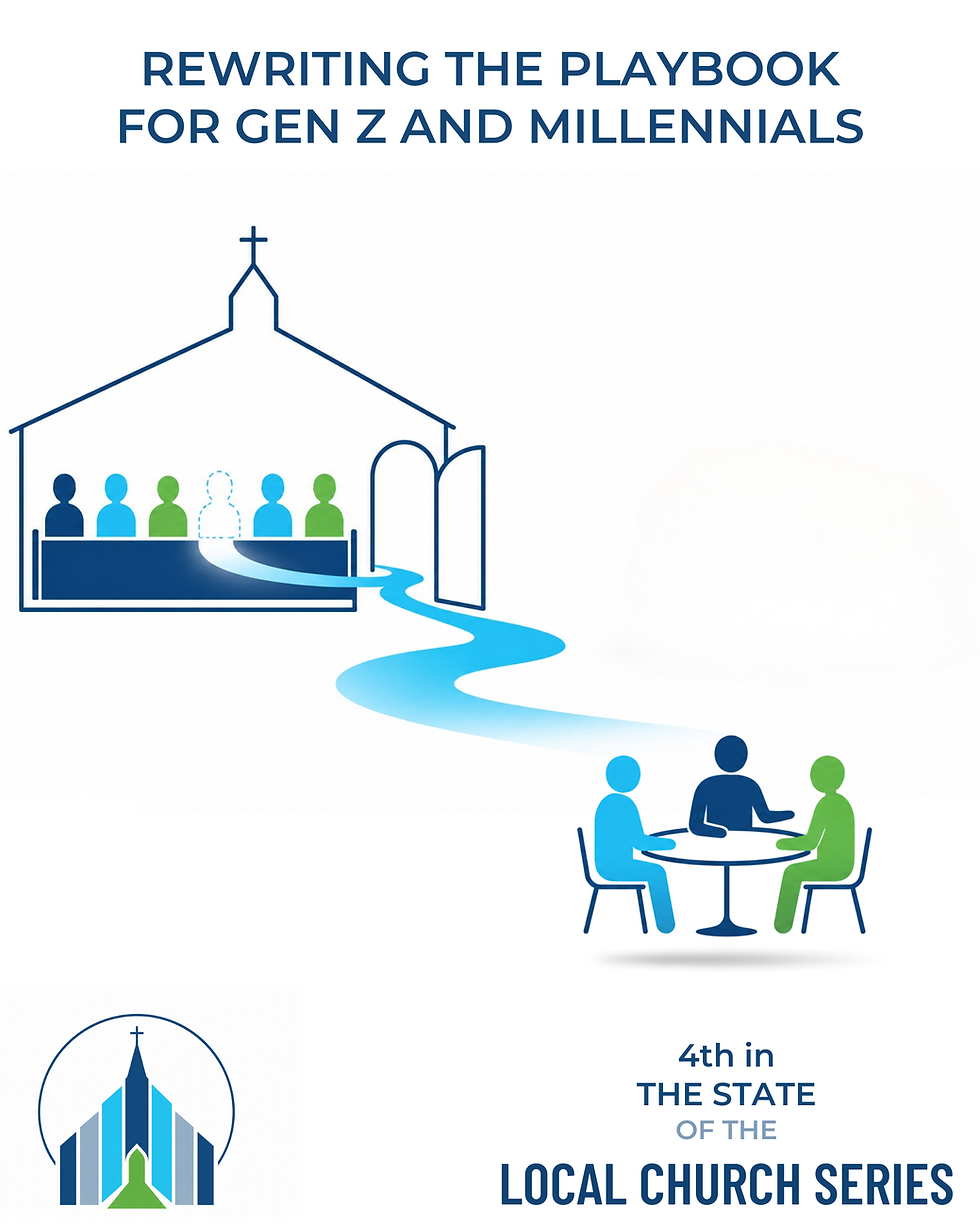
The Missing Generation: Rewriting the Playbook for Gen Z and Millennials
Unplugged Community: The Irreplaceable Power of the Physically Gathered Church
Local Flock, National Noise: Leading Your Church Through Denominational Drama
Prophetic, Not Partisan: Guarding the Gospel in a Hyper-Polarized Culture
The Bi-vocational Revolution: Saving the Small Church Before It Is Too Late
Let’s start with one of the most head-scratching paradoxes in Southern Baptist life today. The numbers are both encouraging and sobering, and—like most things in church life—they need a little more careful interpretation than a headline can give.
The Paradox in the Pews
The 2025 Annual Church Profile reports 12,331,954 Southern Baptist members—the nineteenth consecutive year of membership decline. At the same time, average in-person weekly worship attendance rose 3.63 percent to 4,460,910; small-group and Sunday School participation rose 3.24 percent to 2,650,291; and baptisms rose 4.96 percent to 263,075. That was the fifth consecutive year of baptism growth, something the SBC had not experienced in seventy-five years.1
Now, before we become too excited (or too discouraged), let’s be clear: these numbers don’t mean more people are attending than belong. In fact, across the country, reported membership is still nearly three times the average weekly attendance. And the data don’t tell us exactly how many folks in the pews are actually members. What they do show is this: membership and participation are moving in opposite directions, and that’s worth paying attention to.

We also need to be honest about what these totals can and can’t tell us. In 2025, only 61 percent of SBC churches reported at least one nonfinancial item, and some of the missing numbers were filled in with older data. So, the rebound might actually be bigger than what’s on paper, but we shouldn’t try to squeeze answers out of these numbers that they just aren’t meant to give.2
Which brings us to the heart of the matter. Before we start diagnosing causes, we need to put a finer point on the real problem.
What I Mean by the “Ghost Roster”
Traditionally, a church’s “ghost roster” refers to names that remain on the membership roll even though the people are deceased, have moved, have joined another church, cannot be located, or have not participated in the life of the congregation for years. In that older and still very common problem, the membership roll is much larger than actual attendance. If you've been in a legacy church like I have, you know exactly what I mean.
A newer, opposite problem appears in some congregations—especially younger churches, replants, and churches reaching mobile communities. Regular attenders may worship, give, serve, and place their children in ministry while remaining outside formal membership. In those churches, attendance can equal or exceed reported membership. Thom Rainer has observed both patterns, while noting that the inactive-member problem remains more common.3
Working definition: In this blog, the “Ghost Roster” is the credibility gap between the names a church claims and the people it can actually know, shepherd, disciple, and hold in accountable covenant. The gap has two sides: members who are absent and regular attenders who have not become members. |
This distinction really does matter. There’s a world of difference between a name left in the database because someone has gone home to be with the Lord, a homebound member, a college student away for a semester, a family quietly testing the waters after being hurt, and a longtime attender who just prefers to stay on the sidelines. Healthy churches know better than to lump all these folks into one big category.
Once we start sorting out the two sides of the roster, the reasons for the gap become a little clearer—and a lot harder to blame on just one thing.
Seven Forces Behind the Gap
The studies out there all measure different groups and ask different questions, so we can’t really rank the causes with empirical accuracy. But what they do give us is a clearer picture of several forces all working together—sometimes in ways that surprise us. I actually started this with just three forces, but as I did the research discovered more behind the gap. I’ve ranked them in a descending order.
1. The Deepest Issue: What People Believe the Church Is
Theologically, the deepest issue is a weakened understanding of the local church. Southern Baptists confess that a New Testament church is a local congregation of baptized believers “associated by covenant in the faith and fellowship of the gospel.”4 Membership is not simply having a name in church software. It is a visible, accountable way of saying, “These are my people, these are my shepherds, and this is the body with whom I will worship, serve, give, witness, forgive, and persevere.”
Yet the 2025 State of Theology study found that only 61 percent of Americans with evangelical beliefs agreed that every Christian has an obligation to join a local church, while 44 percent said personal or family worship can replace church attendance. Even regular churchgoers were divided: 57 percent affirmed an obligation to join.5 That is a serious discipleship problem. Still, it should not be mislabeled as the proven largest immediate reason that attenders remain nonmembers.

2. Inertia Is Often More Common Than Rebellion
Lifeway Research offers a needed correction to the idea that sanctuaries are packed with people defiantly rejecting membership. Among Protestant churchgoers who attend at least monthly, 82 percent say they are members of their church. Of the 17 percent who are not members, 39 percent say they have not attended long enough, and 22 percent say they simply have not gotten around to joining. Smaller shares say they do not see the value of membership (15 percent), do not believe it is biblical (8 percent), do not want the responsibility (7 percent), or do not want to be under church authority (3 percent).6
That shifts the pastoral question. Sure, some folks do resist covenant, but many are just waiting for a little clarity, a warm invitation, some time, or a process that actually makes sense. Our job as the church is to teach why membership matters and then make the next step as clear as possible.
3. The Weekly Rhythm Has Thinned
Barna’s 2025 tracking found that churched adults attend an average of 1.6 weekends per month—roughly two out of every five weekends. Gen Z churchgoers averaged 1.9 weekends and Millennials 1.8, an encouraging increase from pandemic lows and, for the first time in decades, higher than older generations.7 The good news is that younger adults are showing up more often. The challenge is that even our most regular generations are present less than half the time.
Someone who comes to church eighteen or twenty times a year may honestly feel connected, but they’re likely missing membership classes, relationship-building moments, ministry invitations, and the kind of steady teaching that helps roots grow deep. Not to mention the difficulty in filling your leadership pipeline. When attendance gets thin, it’s harder to build real belonging and even harder to keep ministry momentum going.
4. Younger Adults Are Less Likely to Join—But the Picture Is Nuanced
Ryan Burge’s analysis of the 2023–24 Pew Religious Landscape Study found that only 25-30 percent of Americans born in 1980 or later belong to a house of worship. That figure includes the religiously unaffiliated and should not be confused with membership among regular evangelical attenders. Among Christians born in 1990 or later who attend weekly, membership is closer to 75 percent; even among the youngest evangelicals, a majority are members.8
The generational challenge is real, but let’s not paint with too broad a brush. Younger adults may be less likely to join institutions, but many will gladly commit when the church offers clear teaching, trustworthy relationships, meaningful ways to serve, and a real reason to belong.
5. Distrust and Church Hurt Travel through the Front Door
Some attenders keep an exit door propped open because they have seen hypocrisy, abuse, scandal, manipulation, or bitter division. Pew’s 2025 research on religious switching found that among the religiously unaffiliated, 49 percent said dislike of religious organizations was an extremely or very important reason for their nonaffiliation, 49 percent cited distrust of religious leaders, and 34 percent cited bad experiences with religious people.9
Now, those numbers are about unaffiliated adults, not regular church attenders who haven’t joined, so we shouldn’t apply them too quickly. Still, they point out that many guests walk into our sanctuaries carrying a lot of baggage. For some, reluctance isn’t apathy—it’s self-protection. We won’t win them over with a harder sales pitch. Instead, we need to build trust with truth, transparency, patient relationships, accountable leadership, and steady care.

6. Consumer Habits Can Hollow Out Commitment
American consumer culture trains us to compare options, keep our options open, receive services, minimize obligations, and leave when preferences are not met. Churches can unintentionally reinforce that instinct when they present worship as an event, ministries as products, and leaders as providers. Thom Rainer has warned that a consumer posture asks what the church will do for me rather than how I will serve Christ and His people.10
The answer isn’t to make guests feel unwelcome—hospitality is a Christian virtue, after all. The real goal is to make the destination clear: we welcome people warmly so that, by God’s grace, spectators become disciples, guests become family, and consumers become servants.
7. Honest Housecleaning Makes Decline Look Worse before It Makes the Church Healthier
Sometimes, what looks like a sudden drop in membership is really just overdue honesty. As Scott McConnell points out, if your membership is more than four times your average attendance, it’s time to clean up the rolls.11 Removing the names of those who have passed away, moved, or can’t be found may shrink the numbers on paper, but it restores integrity to our reporting and helps us see who we’re truly called to shepherd.
Outlining the seven forces of the Ghost Roster, may add clarity, but doesn’t solve the problem. For that I’ve thought through seven ways to narrow the gap. Like anything worth doing, none of these are without its own unique challenges.
Action Playbook: Narrowing the Gap
Measure four numbers honestly: total membership, active membership, average worship attendance, and regular nonmember attendance. Add separate categories for homebound members and others who are providentially hindered. The goal isn’t to make the numbers look good—it’s to get a truthful picture for shepherding.
Teach covenant, not club membership. Preach and disciple from Acts 2:41–47, 1 Corinthians 5 and 12, Hebrews 10:24–25 and 13:17, and 1 Peter 5:1–4. Show how belonging, accountability, the ordinances, service, discipline, care, and mission fit together. Southern Baptists already confess that the local church is a covenant congregation.12
Lower confusion and raise clarity. Make the membership path visible, accessible, and relational. Explain what the church believes, what members promise, what leaders promise, and what changes after someone joins. Lifeway’s research suggests that many nonmembers need a clear invitation more than a debate.13
Conduct a shepherd’s audit in careful stages. Begin with deceased members and confirmed transfers, then people who have moved, people who cannot be found, and finally local nonattenders. Teach before acting, follow the church’s governing documents, document good-faith contact, and move at a pace that is both deliberate and pastoral.14
Have real conversations with regular attenders who haven’t joined. Find the families who are already involved but haven’t taken the step. Ask, don’t assume: ‘What’s kept you from membership?’ Listen for missing information, past hurts, theological questions, scheduling issues, or hesitancy concerning accountability. Then respond to what’s actually holding them back.
Build a shared-care structure. Assign members and regular attenders to pastors, elders, deacons, small-group leaders, or trained care teams according to the church’s polity. Shared ministry makes the flock more visible and prevents every need from flowing to one pastor.
Celebrate every step toward covenant and review the roster regularly. Welcome new members in front of the church, share stories of service and discipleship, and make it a practice to review the roll every year. The best time to keep up with the roster is before it turns into a crisis.
None of these steps will give you instant results. But they will help your church tell the truth, care for people more faithfully, and turn that confusing gap into a real discipleship pathway.
Conclusion: Turn the Roster Back into People
A roster isn’t the church—it’s just a tool. But because every name represents a person, it ought to tell the truth about the congregation God has entrusted to us.

A full room is a blessing, not a problem. An inaccurate roll is a warning sign, not a death sentence. The answer isn’t a careless purge or a watered-down membership. It’s faithful shepherding: clear teaching, gracious invitation, patient trust-building, honest records, meaningful covenant, shared responsibility, and pastoral care that sees the person behind every name.
The Ghost Roster starts to lose its grip when absent members are lovingly pursued, regular attenders are clearly invited into covenant, and pastors remember they are under-shepherds, not saviors. Then the roster becomes more than a database—it becomes a living picture of a real church: believers who are known, loved, equipped, corrected, protected, and sent out together for the glory of Christ.
Endnotes
1. Lifeway Research, “2025 SBC Annual Church Profile Statistical Summary,” May 2026, https://research.lifeway.com/wp-content/uploads/2026/05/2025_ACP_Summary.pdf; Aaron Earls, “Southern Baptists See Attendance and Baptism Gains amid Membership Declines,” Lifeway Newsroom, May 5, 2026, https://news.lifeway.com/2026/05/05/southern-baptists-see-attendance-and-baptism-gains-amid-membership-declines/.
2. Earls, “Southern Baptists See Attendance and Baptism Gains”; Lifeway Research, “2025 SBC Annual Church Profile Statistical Summary,” 1.
3. Thom S. Rainer, “Seven Trends in the Way Churches Are Responding to Inactive Members,” Church Answers, March 25, 2019, https://churchanswers.com/blog/seven-trends-in-the-way-churches-are-responding-to-inactive-members/.
4. Southern Baptist Convention, The Baptist Faith and Message 2000, sec. VI, “The Church,” https://bfm.sbc.net/bfm2000/.
5. Lifeway Research and Ligonier Ministries, The State of Theology: Insights Report (2025), 16–18, https://research.lifeway.com/wp-content/uploads/2025/10/DIGITAL-State-of-Theology-Insights-Report.pdf.
6. Aaron Earls, “Churchgoers Are Likely Also Church Members,” Lifeway Newsroom, November 12, 2024, https://news.lifeway.com/2024/11/12/churchgoers-are-likely-also-church-members/.
7. Barna Group, “New Barna Data: Young Adults Lead a Resurgence in Church Attendance,” September 2, 2025, https://www.barna.com/research/young-adults-lead-resurgence-in-church-attendance/.
8. Ryan Burge, “The Growing Gap in Church Membership,” Association of Religion Data Archives, April 2, 2026, https://www.thearda.com/categories/ahead-of-the-trend/the-growing-gap-in-church-membership.
9. Pew Research Center, Why Do Some Americans Leave Their Religion While Others Stay? (December 15, 2025), 26, https://www.pewresearch.org/wp-content/uploads/sites/20/2025/12/PR_2025.12.15_us-religious-switching_report.pdf.
10. Thom S. Rainer, I Am a Church Member: Discovering the Attitude That Makes the Difference (Nashville: B&H Publishing Group, 2013), 12–25.
11. Earls, “Southern Baptists See Attendance and Baptism Gains.”
12. Southern Baptist Convention, Baptist Faith and Message 2000, sec. VI.
13. Earls, “Churchgoers Are Likely Also Church Members.”
14. Matt Schmucker, “Cleaning Up the Rolls (Part 1),” 9Marks, February 26, 2010, https://www.9marks.org/article/cleaning-rolls/.


Jimmy,
Great thoughts. Difficult to absorb. It took me a couple of times and discussion with Pam to get it all.
Well Done!
Over the last six decades Americans (as a whole) have been growing in their lack of commitment (or covenants) - to : marriage, work oaths, pledge of America flag and to church. Your suggestions are great and should benefit those that listen.
I think churches lack educating on commitment as a service/connection to or picture of our commitment to Christ. I agree that church membership should not be treated as a club membership (although club memberships often require a degree of commitment). It definitely shouldn’t be treated as a monthly pay as you go membership! I can’t wait to read the next blogs.