

UNPLUGGED COMMUNITY


When the world shut down, churches everywhere scrambled to learn how to livestream. Pastors who once struggled to find the mute button suddenly found themselves moonlighting as producers, lighting techs, and camera-angle experts—sometimes before the doors were opened on a Sunday morning. It was during this season that I made the leap to preaching from an iPad mini at the podium.
For a while, the analytics of online ministry felt like a revival breaking out. Three thousand views! Of course, I suspect a few hundred of those folks were just trying to check the weather, but the graph was pointing up. Yessiree.
Digital ministry truly was a gift. Speaking from experience, as a transitional pastor at a struggling church during the Pandemic, it was what kept our ministry wheels turning. Our congregation already had a worship service on various social media, but what used to be an “extra” quickly became the main event. Maybe your church did something similar. We paused in-person worship whenever the public schools closed, and resumed when they reopened. We even split our Sunday mornings into two services—one “masked only,” the other “mask optional.” Attendance was up and down, but the one thing that stayed steady was our online service. It kept the Word going out, connected with our shut-ins, served folks with health or mobility challenges, and gave nervous guests a safe peek through the church window. For all that, we ought to thank God for the gift, not drag the router out to the parking lot and conduct an exorcism.

But now, a few years down the road, we have to ask a tougher question: Did we trade deeper spiritual growth for a bigger audience? Or, to put it another way, did we start treating the church’s front door like it was the living room?
The Honest Claim
Here’s the honest answer. I’m a fan of research—you’ve probably noticed I lean on it quite a bit in this series. But so far, the research hasn’t given us a clear, long-term, apples-to-apples comparison between online and face-to-face discipleship. Most studies look at worship experience, connection, mental health, or participation, but not whether believers are actually becoming more like Christ over five or ten years. Sanctification, it turns out, is pretty stubborn about fitting into a spreadsheet.
So let’s not go around saying, "Science proves online discipleship doesn’t work." The truth is more nuanced. Digital ministry can open doors and offer real spiritual help, but it usually leads to thinner participation and weaker connections than gathering in person. On the other hand, folks who regularly join church small groups tend to show several measurable signs of growing as disciples.

That may not be as dramatic as calling the internet the Antichrist, but it’s a whole lot more helpful.
A Useful Front Door and a Thin Living Room
Pew Research Center surveyed 11,377 American adults in late 2022. Among regular in-person attenders, 65 percent reported a strong connection with fellow worshipers. Among regular virtual viewers, only 28 percent felt strongly connected to the people attending in person, and 22 percent felt strongly connected to other online viewers. Only one-quarter usually felt like active participants; 32 percent felt they were watching without truly participating, while 42 percent said their experience was somewhere between the two.1
Convenience was the most common major reason for watching online, cited by 43 percent. Convenience isn't a sin. It's also not a fruit of the Spirit. Among people who used both formats but preferred attending in person, 52 percent named connection and community as the main reason, more than three times any other answer.2

But let’s not blame online worship for empty pews. A 2024 Hartford Institute survey of over 24,000 churchgoers found that 19 percent moved back and forth between online and in-person worship, while only 4 percent stuck mainly to online. That online-only group showed lower engagement and giving. More than 60 percent of online worshipers admitted to multitasking—probably cooking dinner or ordering socks from Amazon—yet 95 percent said they prayed or meditated, 71 percent sang along, and 87 percent were satisfied with the experience.3 Apparently, you can worship while folding laundry, but I doubt the laundry is holding anyone accountable. I’ll add my own observation here: I think whether people stay focused or start multitasking depends a lot on whether they’re watching alone or with others.
To keep things in perspective, let’s say it this way: a livestream can be a real ministry, but it’s not the whole ministry. It can bring a sermon into someone’s living room, but it can’t, all by itself, bring a person into covenant life, mutual responsibility, and the daily one-anothering we see in the New Testament.
What the Research Says About Presence
A 2025 preregistered experiment offers one of the clearest direct comparisons. Forty-three adult Christians attended both an online and an in-person service in randomized order. During virtual worship, they reported lower transcendent emotion, weaker shared identity with the congregation, and less closeness to God. Their overall well-being scores didn’t differ, and the sample was really small, so one study should not be asked to carry the entire church potluck. Still, its results point toward something many pastors already sense: worship involves more than receiving information.4

A larger national study of 1,717 Americans reached a similar but carefully limited conclusion. After statistical adjustments, in-person religious attendance was associated with better mental and physical health; virtual attendance was not. Because the study was observational and conducted during the pandemic, it cannot prove that the gathering caused those outcomes.5 So we should be cautious in using this definitively.
In addition, other findings also keep us from becoming smug. A 2025 study found that both weekly in-person and virtual attendance were associated with greater social support among women, though not among men, and that this support was indirectly related to lower psychological distress.6 A longitudinal study of 8,951 adults in the United Kingdom also found that online religious participation during lockdown was associated with a few positive outcomes, including lower prevalence of thoughts of self-harm among frequent participants, though there was little evidence of benefit across most of the twenty-one outcomes measured.7
The research isn’t telling us to pull the plug on the internet. It’s saying that online participation can help—sometimes in big ways—but it just can’t replace what happens when believers share a room, a meal, a song, a silence, and a life together.
Discipleship Is More Than Downloading Content
The clearest evidence of discipleship comes from small groups. Lifeway Research's 2026 analysis of 2,130 Protestant churchgoers found that those attending a church small group five or more times a month averaged 74.1 on its discipleship assessment. Those attending no small group averaged 60.4. Frequent participants scored especially high in building relationships, engaging the Bible, serving others, and sharing Christ.8
Now, that’s correlation, not proof that one causes the other. Mature Christians may simply be more likely to join groups in the first place. Still, the pattern matters, because it matches what pastors see and what the New Testament describes. People grow when they study Scripture together, watch each other walk through suffering, confess sin, receive correction, serve side by side, and sometimes find that the prayer request they almost kept quiet about brings someone to their door with a plate of brownies.
Jay Y. Kim argues in Analog Church that digital culture trains us toward speed, choice, and consumption, while Christian formation requires patience, presence, and embodied relationships.9 The issue is not that screens are evil. The issue is that content delivery and disciple-making are not the same assignment.
Acts 2 shows believers devoted to the apostles’ teaching, fellowship, breaking bread, and prayer. Hebrews 10:24-25 calls us to stir one another up to love and good works by meeting together. Galatians 6:2 tells us to bear each other’s burdens, and James 5:16 tells us to confess and pray for one another. All of these commands assume we’re close enough to know what’s really going on in each other’s lives. In other words, discipleship that actually works is personal, sometimes a little intrusive, often messy, and always costly.
The Word became flesh and lived among us (John 1:14, ESV). The Incarnation doesn’t mean a podcast is unspiritual, but it does keep us from treating our bodies like optional accessories. Christian discipleship is embodied because Christian people are embodied.
Six Pastoral Moves
1. Keep the digital door open
Keep livestreaming as long as your church can do it well. The key is to do it well. I’ve seen some churches that probably keep people away because they've seen their livestream. Use digital ministry for seekers, travelers, military families, folks recovering from illness, caregivers, and anyone who just can’t make it in person. Hartford’s research shows that livestreaming doesn’t automatically shrink your in-person crowd. The goal isn’t less reach—it’s reach that leads to real relationships.
2. Give every viewer a human next step
A digital service should make it easy for people to request prayer, talk to a pastor, join a class, meet a member, or show up in person. Have someone host your livestream. Karen and I did this at our home church during the Pandemic, and I promise, it’s not hard. These hosts can be the human connection that follows up. Telling people to "watch again next week" isn’t a discipleship pathway—it’s just a playlist.
3. Put groups near the center
Don’t expect the livestream to carry a load it was never meant to bear. Build strong Sunday School classes, home groups, mentoring relationships, and ministry teams where Scripture is lived out and people are truly known. Train your leaders to notice when someone’s missing, ask a second question, and go beyond just filling an hour with talk.
4. Bring presence to those who can’t come
Don’t let homebound or disabled believers become second-class members who only get church through a screen. A small 2025 study of an online Bible study for people with disabilities found real spiritual support and belonging, but also some tech headaches, isolation, and the loss of face-to-face connection. The researchers called it partial inclusion, not a complete solution.10 So, pair digital access with visits, phone calls, meals, rides, and making your spaces accessible.
A Sunday morning small group we attended set up a live Zoom feed so those in the room could see and hear those online, and vice versa. If someone can’t get to the church, the church can still get to them.
5. Count what views cannot tell you
Views, watch time, and clicks can tell you how far your message went, but they can’t measure repentance, reconciliation, service, or a growing love for Christ. Ask yourself: Are online viewers becoming known? Are they joining groups, receiving pastoral care, serving others, and helping someone else follow Jesus? A dashboard can tell you someone watched, but it can’t tell you if anyone would notice if that person stopped showing up.
6. The Church Still Needs a Body
A livestream can deliver a sermon, but it can’t notice the trembling voice in the hallway after the closing prayer, sit by a hospital bed, hand a grieving friend a tissue before they ask, or hear an evasive answer and gently ask again. Digital ministry can help the church reach someone, but only people can welcome that person into the life of the church.

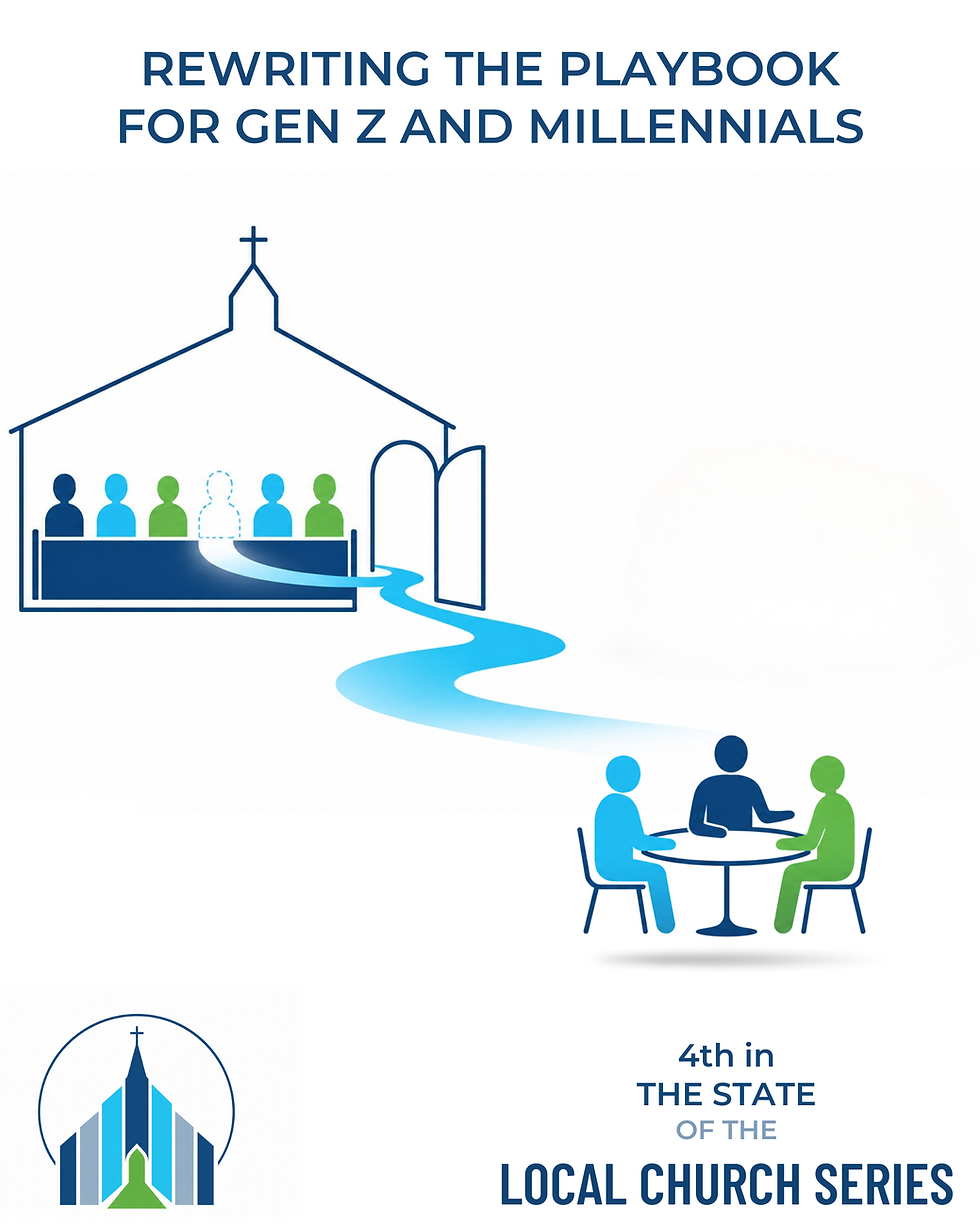
Unplugged community isn’t about being anti-technology. It’s about refusing to confuse transmission with transformation. Use every faithful tool you have. Then invite people into the room, around the table, under the Word, beside the hurting, and into the work of ministry.
The church doesn’t need less reach. It needs reach that turns into real relationships—relationships where the Holy Spirit shapes people into the likeness of Christ.
I hope this gives you a balanced perspective on digital ministry. There’s so much more we could explore here, and honestly, it seems like every week brings a new technology that might bring us together or push us further apart. Wi-Fi may open the front door, but someone still has to invite people in, learn their names, and make room on the couch.
Endnotes
1. Pew Research Center, "Online Religious Services Appeal to Many Americans, but Going in Person Remains More Popular," June 2, 2023, https://www.pewresearch.org/religion/2023/06/02/online-religious-services-appeal-to-many-americans-but-going-in-person-remains-more-popular/.
2. Michelle Faverio and Justin Nortey, "Why Some Americans Prefer In-Person Worship over Virtual Services," Pew Research Center, September 6, 2023, https://www.pewresearch.org/short-reads/2023/09/06/why-some-americans-prefer-to-go-to-religious-services-in-person-and-others-prefer-to-watch-virtually/.
3. Ryan Panzer, "Liturgy in the Living Room: New Study Shows Online Church Isn't Killing In-Person Attendance," Exploring the Pandemic Impact on Congregations, June 16, 2025, https://www.covidreligionresearch.org/study-shows-online-church-attendance/.
4. Patty Van Cappellen, Camden Nelson, and Jenna F. McClear, "The Power of Presence: Well-Being and Biopsychosocial Effects of Virtual Versus In-Person Religious Services," Psychology of Religion and Spirituality 17, no. 4 (2025): 499-503, https://doi.org/10.1037/rel0000575.
5. Laura Upenieks, Terrence D. Hill, Gabriel Acevedo, and Harold G. Koenig, "'Electronic Church' 2.0: Are Virtual and In-Person Attendance Associated with Mental and Physical Health during the COVID-19 Pandemic?" Sociology of Religion 84, no. 3 (2023): 292-323, https://doi.org/10.1093/socrel/srac043.
6. Laura Upenieks and Terrence D. Hill, "Gender Variations in the Indirect Effects of In-Person and Virtual Religious Attendance on Psychological Distress during the COVID-19 Pandemic," Social Currents 12, no. 2 (2025): 111-128, https://doi.org/10.1177/23294965241300719.
7. Koichiro Shiba et al., "Associations of Online Religious Participation during COVID-19 Lockdown with Subsequent Health and Well-Being among UK Adults," Psychological Medicine 53 (2023): 3887-3896, https://doi.org/10.1017/S0033291722000551.
8. Aaron Earls, "Small Group Participation Linked to Higher Discipleship Scores," Lifeway Research, August 4, 2026, https://research.lifeway.com/2026/08/04/small-group-participation-linked-to-higher-discipleship-scores/.
9. Jay Y. Kim, Analog Church: Why We Need Real People, Places, and Things in the Digital Age (InterVarsity Press, 2020).
10. Talia Opperman and Michelle Botha, "The Potential and Challenges of an Online Bible Study Group for Persons with Disabilities," African Journal of Disability 14 (2025): a1721, https://doi.org/10.4102/ajod.v14i0.1721.


Comments