

THE FRUIT DOES NOT LIE

Updated: Jun 5

There’s a certain kind of Christian who stands out, and not because they make a big show of it. They don’t walk in carrying a Bible the size of a Costco roast. They don’t broadcast their spiritual credentials like someone spraying cologne at the mall. They just show up, and somehow, you notice the atmosphere is different.
They listen without defending or accusing. They disagree without becoming disagreeable. They forgive without requiring a public apology. When they speak the truth, it doesn’t feel like you’re being hit with a sledgehammer. They aren’t pushovers, but they have a strength that looks a lot like Jesus. Their lives carry a kind of weight, warmth, and goodness you can sense.
That is what Paul calls 'the fruit of the Spirit.' Not the religious personality type. Not the checklist of church behaviors. Not the 'I was raised right and know which fork to use at a fancy Buckhead, GA restaurant. Rather, the fruit of the Spirit is the visible evidence that the invisible life of God is actually growing in a human being.

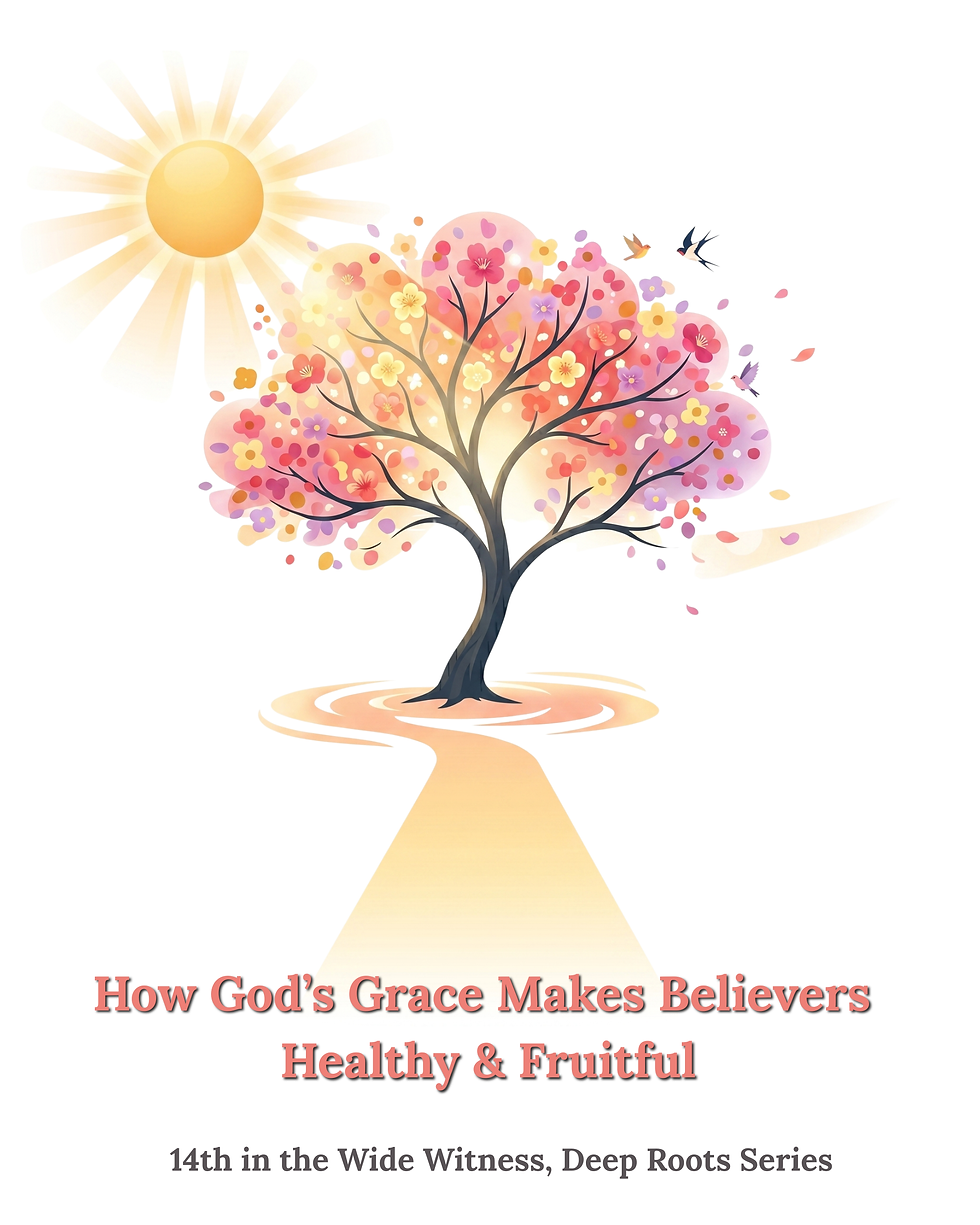
This fruit shows up and grows as we live under the grace of Jesus, learning to line up our lives with what His Spirit is doing. Think of it like a Christian Character Tree. The fruit of the Spirit is the top of the tree, where everything God has been doing in us finally shows up for everyone to see.
Remember, the fruit isn’t the goal—it’s the result. It’s what grows out of everything God has already planted and nurtured in us: the new birth, the deep roots of kingdom values, the nourishment of Scripture and spiritual disciplines, and the warm light of God’s grace. The fruit of the Spirit is the proof that God is really at work in a person’s life, or in a church family living under His care.
This “fruit of the Spirit” is outlined in the Apostle Paul’s letter to the Galatians. Paul wrote this letter to churches being tempted to trade the living gospel for religious machinery. Some teachers were telling Gentile believers they needed Christ plus circumcision, faith plus law-keeping, grace plus a little spiritual resume padding. For these people, entry into Christ may have been by faith, but, contrary to the gospel and to Paul, life in Christ was according to the Law. The Law doesn’t give life; that comes from the Spirit. We are to live not by the Law but by the Spirit, and evidence of this is the fruit of the Spirit. Needless to say, Paul was not amused. Galatians is not Paul sipping a Celestial Seasonings herbal decaf tea and gently processing his feelings. It is Paul pulling the fire alarm because the house of grace was filling with smoke.1
And right in the middle of that emergency, Paul gives us this beautiful sentence: “But the fruit of the Spirit is love, joy, peace, patience, kindness, goodness, faithfulness, gentleness, self-control” (Gal. 5:22-23, ESV). That little cluster of words is not a decorative Bible verse for an entry wall. It is the apex of Christian character. It is the place where the whole tree finally tells the truth.

The fruit matters because fruit verifies the tree. Jesus said you know a tree by its fruit, not by its press release (Matt. 7:16-20; Luke 6:43-45). Any church, pastor, deacon, Sunday School teacher, theologian, associational missionary like me, or denominational committee can print values on a brochure. But the question is not, “What do you say you value?” The question is, “What grows naturally when life squeezes you?”
When the email is sharp, what comes out?
When the meeting goes sideways, what comes out?
When someone else gets praised, what comes out?
When the budget goes awry, what comes out?
When you’re tired, contradicted, overlooked, or treated like the church copier—used all the time and blamed when things go wrong—what comes out?
That is fruit inspection. And yes, it is uncomfortable. Nobody likes being spiritually squeezed. But squeezing does not usually create what comes out; it reveals what was already in there. Jesus said as much when he said, “all these evil things come from within, and they defile a person.” (Mark 7:23)
The fruit of the Spirit is the culmination and verification of the Christian Character Tree. The soil may be rich. The roots may be deep. The trunk may be sturdy. The limbs may stretch toward heaven. But fruit is where the tree's life becomes visible, edible, shareable, and undeniable. Fruit is not the whole tree, but it is the part of the tree your neighbor gets to taste.
So what is the fruit of the Spirit?
I’m glad you asked. First, it is singular. Paul says 'fruit,' not 'fruits.' This really does matter. Love, joy, peace, patience, kindness, goodness, faithfulness, gentleness, and self-control are not nine spiritual electives, as if we could major in joy, minor in kindness, and audit self-control without doing the assignments. They are one unified harvest of the Spirit's life.2
Second, the fruit is Christlike character produced by the Holy Spirit. It is the life of Jesus taking recognizable shape in us. Love is not simply niceness. Joy isn't a glittering personality. Peace isn’t conflict avoidance. Patience isn’t pretending nothing bothers you while your left eye twitches. Kindness isn’t cowardice with manners. Goodness isn’t self-righteous fussiness. Faithfulness isn’t stubbornness baptized. Gentleness isn’t weakness. Self-control isn’t grim personal management by your own Internal Department of Religious Compliance. I think you get it.
The fruit is the moral fragrance of Jesus.
C. S. Lewis helps us here. In The Four Loves, Lewis shows how natural loves are good gifts, but they become disordered when they refuse the rule of divine love.3 That insight helps us see why the Spirit must grow love in us. Human love, left to itself, can become possessive, needy, sentimental, manipulative, or tribal. Spirit-grown love becomes holy love - love that seeks the good of the other before the applause of the self.

J. R. R. Tolkien gives us another picture. In The Lord of the Rings, the Shire is worth saving not because it is impressive, but because it is fruitful, ordinary, earthy, relational, and good.4 For Tolkien, the Great War mattered because gardens, meals, friendships, songs, children, and peaceful fields mattered. In Christian terms, fruit is what makes the battle visible in ordinary life. Spiritual warfare is not only resisting obvious darkness; it is becoming the kind of person whose presence makes a little more Shire appear in Mordor. So, if you’re unfamiliar with Tolkien, the point is that the fruit of the Spirit makes God’s kingdom quietly visible even in places in which darkness seems to have the upper hand.
Now, what is the fruit not?
It could be helpful to define what the fruit of the Spirit is not. It is not personality. Some people are naturally calm, cheerful, disciplined, or agreeable. That may be temperament, upbringing, Southern politeness, or caffeine levels. The Spirit can certainly sanctify temperament, but temperament is not the same as fruit. A naturally quiet person may not be gentle; he may be passive, fearful, or rehearsing a devastating comment for later. A naturally energetic person may not be joyful; she may simply be running on adrenaline and denial.
It’s not only about managing your behavior. Of course, behavior matters. But Christian character doesn’t come from trying to staple fruit onto dead branches. Nobody wants to eat a pie made from that. If all we do is decorate the outside, sooner or later, the tape comes loose, and the fake fruit falls off.
It’s not factory output, either. Factories make things by pressure, speed, repetition, and control. Trees grow fruit by life, rootedness, season, atmosphere, pruning, and time. A factory can produce identical widgets. A tree produces living fruit. Modern church life sometimes prefers factories because factories are measurable, efficient, and easy to report in a spreadsheet. “How many units of kindness did we ship this quarter?” But the Holy Spirit isn’t running an assembly line. He’s growing an orchard.
This changes our approach to spiritual growth. If fruit is factory output, then we need more pressure. If fruit is behavior management, then we need more rules. If fruit is religious marketing, then we need better branding. But if fruit is organic life, then we need health from the roots upward.
Where does the fruit come from?
It comes from the Holy Spirit, through union with Christ, under the sunlight of God’s grace, rooted in the reality of truth, goodness, and beauty. Gordon Fee emphasized that for Paul, the Spirit is the experienced presence of God among and within His people.5 J. I. Packer famously described the Spirit's ministry as floodlight-like: the Spirit shines a spotlight on Christ, not Himself.6 That means the Spirit grows Christlike fruit in us by making Christ real, beautiful, trusted, loved, and obeyed.
In the Christian Character Tree, the fruit does not appear in midair. It grows from the whole living ecological environment. In case you missed it on other blogs, here's the summary from the ground up.

The soil is the reality of, alignment with, and radience of God - the rich ground of the good, the true, and the beautiful. If there’s no grounding, there’s no growth. The soil of Truth roots us in reality. Fruit cannot grow in delusion. Love must love what is actually good. Joy must rest in what is real. Peace must be more than denial with mood lighting.
The soil of Goodness secures us in the moral order. The fruit of the Spirit isn’t random pleasantness. It’s a rightly ordered life. The good life is the life that’s lived in harmony from the inside out according to God’s design.
The soil of Beauty holds us in the radiance of a rightly ordered soul. The fruit isn’t only correct; it’s lovely. Beauty has been called the child produced by the marriage of the True and the Good. Dallas Willard said it well: "Beauty is God's goodness made manifest to the senses."7 Beauty is the sensory evidence of God.
The seed is new life from the Spirit. It is God’s living design.
The roots are the deep postures of the kingdom, rooting and sprouting from this new Spirit-life: poverty of spirit, meekness, hunger for righteousness, mercy, purity of heart, peacemaking, and endurance.
The nutrients are the supplements drawn from the soil by the roots’ values. Peter describes: faith, virtue, knowledge, self-control, steadfastness, godliness, brotherly affection, and love (2 Pet. 1:5-7).
The sunlight of God’s grace shines on the entire tree. This is God’s fatherly favor, providential care, transforming power, sustaining strength, timing, and more.
The atmosphere of the Holy Spirit surrounds the tree. He is breath, wind, presence, and power. He does not simply give us assignments; He gives us life. He convicts, comforts, illuminates, empowers, and bears witness to Christ. The Christian life is not lived by holding our breath and trying to look spiritual. It is lived by breathing the air of the Spirit.
The trunk is the stabilizer. These four virtues of prudence, justice, temperance, and fortitude are the hinge on which the rest of the moral life and a flourishing society depend.
The limbs are the three theological virtues of faith, hope, and love, from which the fruit of the spirit can bloom and ripen. These virtues are gifts of God to his own.
All of this is the gift of God. But our cooperation and effort are not excused in this fruit-bearing enterprise. Dallas Willard's famous line, which I’ve used over and over, is crucial here: “Grace is not opposed to effort. It is opposed to earning.”8 That is the difference between spiritual formation and spiritual self-salvation—our effort matters. We abide. We pray. We repent. We forgive. We practice silence instead of narrating every irritation like a breaking news anchor. We open Scripture. We worship. We confess. We serve. We stay in Christian community even when the community contains actual Christians, which is often where the trouble begins.
But none of that earns fruit. However, it does position us to receive life.
This is why the sap in the Christian Character Tree matters so much. The sap is the Spirit bringing us grace through things like Scripture, prayer, worship, obedience, fellowship, gratitude, lament, Sabbath, and being together as a church. Sap isn’t flashy, but without it, the branches dry up. A lot of us want fruit but ignore the sap. That’s like wanting apples without bothering with roots, rain, or sunlight because they don’t seem exciting enough.

The weather, pruning, and orchard also matter. These are trials, discipline, suffering, community, mission, and witness. God uses storms. God uses pruning. God uses difficult people, which is both biblical and inconvenient. He uses the church, which is why spiritual maturity cannot be reduced to private inspiration and a good playlist. Fruit grows in the orchard of shared life.
So what is God's part and what is our part?
God gives life. God unites us to Christ. God sends the Spirit. God justifies. God adopts. God sanctifies. God prunes. God preserves. God brings the harvest.9
Our part is responsive participation. We walk by the Spirit (Gal. 5:16). We keep in step with the Spirit (Gal. 5:25). We put to death the deeds of the body by the Spirit (Rom. 8:13). We abide in Christ because apart from Him we can do nothing (John 15:5). We do not create the sap; we stay connected to the Vine.
This is why fruit is so important. It reveals the kind of tree and the state of the heart. The fruit of the Spirit is not how we earn salvation, but it is one way salvation shows up, wearing what we used to call in Texas “work clothes”. It matters because the world is tired of Christian leaves without Christian fruit. The world will curse us as Jesus cursed the fig tree on his way to Jerusalem. In my opinion, people have seen enough religious foliage - platforms, slogans, theological framework conferences, doctrinal cage matches, and online discernment ministries that seem to have lost the 'gentleness' aisle.

The world does not need less truth. It needs truth with fruit. Truth without love becomes a sword in the hands of a toddler. Goodness without gentleness becomes moral bullying. Faithfulness without joy becomes grim endurance with a hymnbook. Self-control without kindness becomes emotional refrigeration. The fruit holds together.
The fruit is also deeply relational. Every aspect of the fruit has a face turned toward God and a face turned toward neighbor.
Love seeks another's good.
Joy strengthens shared life.
Peace makes room for reconciliation.
Patience absorbs slowness without contempt.
Kindness gives warmth where coldness would be easier.
Goodness acts for what is right, not simply what is convenient.
Faithfulness stays when novelty leaves.
Gentleness handles souls without bruising them.
Self-control refuses to make everyone else pay for our appetites, fears, moods, and impulses.
In other words, the fruit of the Spirit is what love looks like when it gets dressed for different occasions.
In marriage, fruit sounds like, 'I was wrong.'
In parenting, it sounds like calm strength instead of volcanic correction.
In church conflict, it sounds like truth with tears instead of truth with brass knuckles.
In leadership, it sounds like courage without ego.
In suffering, it sounds like hope that has stopped needing everything to be easy.
In social media, it sounds like logging off before posting what your flesh just wrote in your head.
The fruit is for God's glory, our maturity, the church's health, and the neighbor's good. Jesus said the Father is glorified when His disciples bear much fruit (John 15:8). Fruit glorifies God before it is practical. It shows that God is a living God who can make living people. It also makes the church a credible preview of the kingdom. Not a perfect preview, of course. More like a church homecoming potluck version of the kingdom - some dishes are excellent, some are mysterious, and somebody always brings a strange salad with marshmallows. But still, a preview.
The fruit is also missional. Christopher Wright has emphasized that God's people are called to reflect God's character for the sake of God's mission in the world.10 The fruit of the Spirit is not private spirituality kept in a devotional greenhouse. It is public witness. The church's love, joy, peace, patience, kindness, goodness, faithfulness, gentleness, and self-control are meant to make the invisible reign of Christ visible in ordinary neighborhoods.
This is where we must resist two opposite errors.
The first error is passivity: 'Let go and let God,' meaning, 'I will do nothing and call it faith.' That is not spirituality; that is laziness wearing a church name tag.
The second error is moralism: 'Try harder and become better,' meaning, 'I will now produce divine life by clenching my jaw.' That is not sanctification; that is spiritual CrossFit without the Holy Spirit.
The biblical way is dependent effort. We act because God is at work in us (Phil. 2:12-13). Jerry Bridges expressed this balance well by insisting that holiness requires disciplined obedience while remaining rooted in grace.11 John Stott likewise saw Galatians 5 as contrasting the flesh-driven life with the Spirit-led life, not between effort and no effort.12 The question is not whether we act. The question is whether our action grows from grace or from self-salvation.
Here is the practical pathway.
Start with the soil. Return to reality. Ask: Am I living in truth, goodness, and beauty, or am I trying to grow spiritual fruit in fantasy, disorder, and ugliness?
Stand in the sunlight. Receive the grace of God. You are not loved because you are fruitful. You become fruitful because you are loved.
Breathe the atmosphere. What air are you breathing? Outrage? Hurry? Resentment? Comparison? Entertainment escapeism? Constant noise? The soul cannot breathe carbon monoxide and produce peaches. Create space for Scripture, prayer, worship, silence, confession, and Christian friendship. You know you need it.
Strengthen the roots. Ask what you honestly value. The fruit of peace will not grow from roots wrapped around control. The fruit of kindness will not grow from roots drinking contempt. The fruit of self-control will not grow from roots feeding on entitlement.
Build the trunk. Practice prudence, justice, temperance, and fortitude. Stretch the limbs. Live by faith, hope, and love. The virtues do not replace the Spirit; they give shape and strength to Spirit-formed character.
Receive pruning. Jesus said the Father prunes fruitful branches so they bear more fruit (John 15:2). Pruning is not punishment. It is love with shears.
Practice the fruit relationally. Don’t simply admire patience. Be patient with the slow cashier line, the difficult church member, the child asking the same question for the eighth time, and the person who tells a story with more exits than the Atlanta airport.
Stay connected to Christ. Fruit comes from abiding, not from visiting or occasional checking in. Abiding.
The fruit of the Spirit is the apex of Christian character because it is where doctrine becomes disposition, where grace becomes reflex, where truth becomes beauty, and where the hidden life of the Spirit becomes visible in the believer's common Tuesday.

A mature Christian is not someone who merely knows more Bible, though we desperately need biblical depth. A mature Christian is someone who increasingly resembles the Christ to whom the Bible bears witness. The aim is not to become a religious expert with a personality problem. The aim is to become the kind of person who can do what Jesus would do if He were us - because His Spirit is forming His life in us.
That is why the fruit matters.
Not because it makes us impressive.
Not because it gives us spiritual bragging rights.
Not because it earns God's favor.
It matters because fruit means the tree is alive.
And in a world full of plastic plants, artificial flowers, fake smiles, manufactured outrage, and factory-made religion, a living tree is a miracle.
So stand in the soil of truth, goodness, and beauty. Receive the sunlight of God’s grace. Breathe the atmosphere of the Spirit. Let the sap flow through the means of grace. Sink your roots deep. Strengthen the trunk. Stretch the limbs. Receive the pruning. Keep in step. Stay in the orchard.
And over time—usually slower than we’d like, deeper than we expect, and more beautiful than we deserve—the fruit will come.
Endnotes
1. My summary of the situation at Galatia came from Thomas R. Schreiner, Galatians, Zondervan Exegetical Commentary on the New Testament (Grand Rapids: Zondervan, 2010), and Douglas J. Moo, Galatians, Baker Exegetical Commentary on the New Testament (Grand Rapids: Baker Academic, 2013).
2. Gordon D. Fee, God's Empowering Presence: The Holy Spirit in the Letters of Paul (Peabody, MA: Hendrickson, 1994); John R. W. Stott, The Message of Galatians, The Bible Speaks Today (Downers Grove, IL: InterVarsity Press, 1968).
3. C. S. Lewis, The Four Loves (London: Geoffrey Bles, 1960), pp. 171-173.
4. J.R.R. Tolkien, The Hobbit: Illustrated By The Author (William Morrow, 2023), p. 62.
5. Fee, God's Empowering Presence.
6. J. I. Packer, Keep in Step with the Spirit: Finding Fullness in Our Walk with God, rev. ed. (Grand Rapids: Baker Books, 2005), p.57.
7. Dallas Willard's Definitions and Quotes - Soul Shepherding, accessed October 2, 2025, https://www.soulshepherding.org/dallas-willards-definitions/
8. Dallas Willard, The Great Omission: Reclaiming Jesus's Essential Teachings on Discipleship (San Francisco: HarperOne, 2006), p. 61.
9. Kenneth Boa, Conformed to His Image: Biblical and Practical Approaches to Spiritual Formation (Grand Rapids: Zondervan, 2001), pp. 292-295. Ref: Romans 8:29; Ephesians 1:3-14; Ephesians 2:8-10.
10. Christopher J. H. Wright, The Mission of God: Unlocking the Bible’s Grand Narrative (Downers Grove, IL: IVP Academic, 2006), 368–69.
11. Jerry Bridges, The Discipline of Grace: God’s Role and Our Role in the Pursuit of Holiness (Colorado Springs: NavPress, 2006; repr., Carol Stream, IL: Tyndale House, 2018), vii–viii, 17–18.
12. John R. W. Stott, The Message of Galatians: Only One Way, The Bible Speaks Today (Leicester, England: Inter-Varsity Press; Downers Grove, IL: InterVarsity Press, 1968; repr., 1986), 146–50.


Comments