

The Atmosphere of the Spirit


The Air We Forget We Are Breathing
Back when sailing ships ruled the seas, the clipper was the pride of the ocean. These beautiful ships had tall masts, more sails than you could count, and hulls built for speed. But if one of these ships sailed into the Doldrums—a stretch of ocean near the equator where the wind just gives up and goes on vacation—all that fancy design didn’t matter one bit. The sails drooped, the ship sat still, and the crew could do everything from scrubbing the decks to rowing until their arms gave out, but they weren’t going anywhere. They needed something they couldn’t create on their own: the wind.

If we’re honest, we often try the same thing in our Christian lives. We need–no–we must have the Holy Spirit moving in our lives, but instead we treat Him like the backup generator—good to have in case of emergency, but not something we think about much. He gets a mention in our doctrinal statements, but when it comes to living out our faith, we act like Christian character is mainly a matter of better education, stronger willpower, and image management. In short, we live in the Doldrums, trying to row the ship ourselves, giving little thought to the massive power that we would have if we would but raise the sails.
That just won’t cut it.
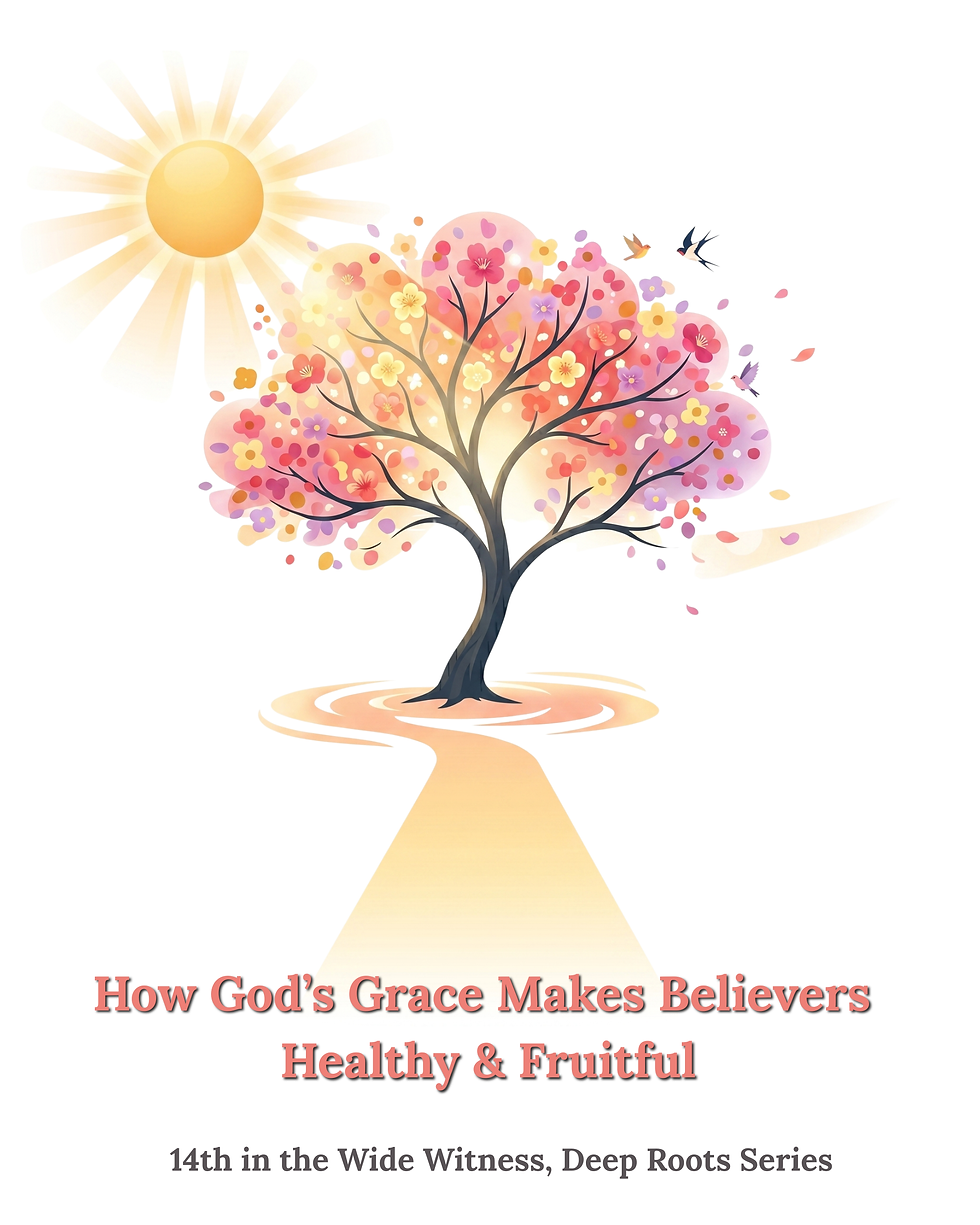
When it comes to the Christian Character Tree, the Holy Spirit isn’t some late addition or an optional upgrade for the super-spiritual folks. He’s not the extended warranty package for believers who want a little extra holiness coverage. The Holy Spirit is the very air the tree breathes—the atmosphere where it lives, grows, bends, heals, and bears fruit.

A tree doesn’t decide to breathe only on certain days. It either lives in the air or it doesn’t live at all. In the same way, Christian character doesn’t grow if we try to go it alone through self-effort. It grows in the presence, power, comfort, conviction, and life-giving breath of God’s Spirit.
This means the Spirit is present from beginning to end: in the soil, awakening the seed, reordering root values, deepening Beatitude roots, helping the soul absorb the nutrients of 2 Peter 1:5-7, moving through the sap of the means of grace, strengthening the trunk of Cardinal virtues, lifting the limbs of faith, hope, and love, ripening the fruit, steadying the tree through weather, guiding the pruning, and filling the orchard of the church.
Without Him, the tree isn’t just weak—it’s dead.
The Spirit as Atmosphere: The Personal Presence Around the Whole Tree
Before we talk about roots, nutrients, disciplines, virtues, and fruit, we must begin where Scripture begins: with the Spirit hovering over the waters, bringing life where there was formlessness and emptiness (Genesis 1:2). The Spirit is the divine breath of life. Job says, “The Spirit of God has made me, and the breath of the Almighty gives me life” (Job 33:4). Ezekiel sees a valley of dry bones, and life comes only when the breath of God enters them (Ezekiel 37:1-14).1
This is important because Christian character doesn’t start with you deciding to pony up and get serious. It starts with God giving life. Remember Nicodemus? He had Bible knowledge, a solid reputation, and probably the coolest sandals in Jerusalem. But Jesus didn’t tell him, 'Nicodemus, you just need to try harder.' Instead, Jesus said, 'You need a new birth—something you can’t make happen on your own.' (John 3:3-8)
That is where the Christian Character Tree begins. The Spirit gives new birth, unites us to Christ, indwells us, seals us, leads us, empowers us, and bears witness that we are children of God (Romans 8:14-16). He is not an impersonal force, like theological electricity. He is the third person of the Trinity, the Lord and giver of life. The atmosphere image is useful only if we remember that this atmosphere is personal. We do not breathe a vague spiritual mood. We live before and by the Holy Spirit of God.2
Gordon Fee was right to press Christians to recover the centrality of the Spirit in the Christian life. The New Testament does not imagine a church that believes orthodox doctrines about the Spirit while, in practice, attempting sanctification through its own religious muscle. The Spirit is not decoration. He is life.3
I hope you get my point. Without the Holy Spirit giving zoe, or Spirit-life, we have no hope of developing the character of Christ in us. So we must continually seek His presence and submit to His Word and to His will for us.
With this understanding, we can move on to the work of the Holy Spirit in the foundational reality of Christian Character.
The Spirit and the Soil: Truth, Goodness, and Beauty Made Livable
The Christian Character Tree grows in the soil of the Transcendentals: Truth, Goodness, and Beauty. This is not meant to be decorative terms or abstract language. The Transcendental soil is the manifestation of God himself. It is living, real, and knowable. It is the difference between growing in God’s reality and trying to plant character in the loose gravel driveway of cultural confusion.
Truth is not what the loudest person on the internet declares or what most people “like.” Goodness is not what feels right at the moment. Beauty is not just what photographs well. Truth, Goodness, and Beauty are grounded in God Himself and revealed fully in Jesus Christ, who is "the way and the truth and the life" (John 14:6). We’ve gone over all this before.
The Holy Spirit keeps this soil alive. Jesus calls Him “the Spirit of truth” (John 16:13). The Spirit doesn’t lead believers into make-believe spirituality. He does not fertilize delusion. He anchors the soul in reality as God defines it. And God defines it the way He does because reality is found in Him. He is the source and the definition. For us, God uses the Word to sanctify us in truth (John 17:17), and He teaches us to dwell on what is true, honorable, just, pure, lovely, commendable, excellent, and praiseworthy (Philippians 4:8).
We need this desperately because our world is pretty good at poisoning the soil and then acting surprised when the trees look sick. We breathe in outrage, scroll through envy, snack on distraction, and soak in self-expression. Then we wonder why joy, peace, patience, and self-control can’t be found in the latest prescription drug commercial.

Peter Kreeft and Thomas Aquinas have helped me see that Truth, Goodness, and Beauty are not three random inspirational words. They name the shape of reality under God. Yet the Spirit makes them more than concepts. He makes truth honest, goodness desirable, and beauty holy. He teaches us that obedience is not God ruining our weekend, but God restoring us to sanity.4
The Spirit Awakens the Seed of God’s Living Design
The seed in the Christian Character Tree represents God’s living design and redemptive purpose. It is not like a blueprint. It is a living, growing design with purpose.
God’s purpose is that believers be “conformed to the image of his Son” (Romans 8:29). That is the design inside the seed. The goal is not to become a slightly less irritating version of ourselves. The goal is Christlikeness; or as Dallas Willard described it as becoming like Christ in moral and character formation, so that, by grace, we increasingly do what Jesus would do if He were us.
The Spirit plants and awakens this life through the gospel. He gives new birth. He joins us to Christ. He seals us as God’s own. He brings us into adoption so that we do not grow as spiritual orphans, forever trying to impress a Father who has already welcomed us in the Son. Todd Billings’s emphasis on union with Christ helps us here. Sanctification is not God handing us a checklist and saying, “Good luck becoming holy.” It is life in Christ by the Spirit.5
The same Spirit who awakens faith also forms character. The same Spirit who makes us alive also makes us grow. The seed does not say, “I shall now become impressive”, and then have the power to follow through. The seed receives life, opens, responds, and grows because the Spirit has breathed into it.
This protects us from two opposite errors. One error says, “I can grow myself if I just try hard enough.” The other says, “Since growth is God’s work, I will just sit back and watch.” Scripture rejects both. God gives life, and living things grow. Grace comes first, but grace never leaves the tree dormant in the dirt. Paul wrote to the Corinthians how by God’s grace he was who he was, yet he labored more than anyone, but it was not himself, but the grace of God that was in him. (1 Corinthians 15:10)
The Spirit Reorders Root Values: What the Soul Learns to Prize
Before roots absorb nutrients, the soul must learn what’s nourishing. This is where root values matter. Values are the root permissions of the soul. They decide what the roots reach for.
If the soul prizes comfort more than Christ, it will absorb excuses. If it prizes approval more than truth, it will absorb flattery. If it prizes control more than faith, it will absorb anxiety and may even call it responsibility. If it prizes platform more than people, it will absorb applause while starving love.
The Holy Spirit reorders what we love.
This is why moral instruction alone is not enough. You can tell a greedy heart that generosity is good, but that doesn’t make generosity desirable. You can tell an angry person that gentleness is biblical, but that doesn’t make gentleness feel safe. You can tell a distracted Christian to pray more, but if the soul prizes noise, prayer will feel like punishment.
John Owen understood that sin is not just bad behavior sitting on the surface. It is a disordered desire deep in the person. Dallas Willard similarly warned that the body and its habits must be retrained under Christ. The Spirit does this deep work, not by zapping us into instant maturity, but by reorienting our love through grace, Scripture, worship, obedience, confession, and ordinary practice.6

The Spirit teaches us to value veracity over spin, teachability over defensiveness, integrity over image management, liberation over indulgence, grit over comfort, honor over usefulness, faithfulness over drift, splendor over cheap spectacle, thankfulness over entitlement, adoration over idolatry, and assurance over panic.
This isn’t a weekend project. To borrow Willard’s terminology, it’s a holy renovation of the heart. And let’s be honest, like sanding down a popcorn ceiling, the dust gets everywhere.
The Spirit Deepens the Beatitude Roots
The Beatitudes are the root system of Christian character. They are not greeting-card inspirations from Dollar Tree. They are the hidden postures of people who live under the reign of Christ: poor in spirit, mourning, meek, hungry for righteousness, merciful, pure in heart, peacemaking, and faithful under pressure (Matthew 5:1-12).7
The Spirit grows these roots deep underground, where nobody is offering applause.
That’s a little inconvenient, because most of us would like to see visible fruit arrive by one-day Amazon Prime. We want patience without having to wait, meekness without anyone misunderstanding us, mercy without difficult people, purity without temptation, peacemaking without conflict, and righteousness without any cost. In other words, we want resurrection without crucifixion—which sounds nice, but it’s not the way God works, or the gospel.
D. Martyn Lloyd-Jones saw poverty of spirit as the first great mark of kingdom life: the end of self-reliant pride before God. That is where the roots begin. The Spirit brings us low, not to crush us, but to make us receptive. Proud roots do not drink grace. They admire themselves while drying out.8

Looking at ourselves, the Spirit softens the soil of the heart. He opens roots that sin has clenched shut. He teaches us to mourn without despair, hunger without self-righteousness, forgive without superiority, and endure without becoming hard. He develops a hidden receptivity to the kingdom before He produces public evidence of it.
The Spirit Helps the Roots Absorb the Nutrients of 2 Peter 1:5-7
Second Peter 1:5-7 gives the nutrients of Christian growth: faith, virtue, knowledge, self-control, steadfastness, godliness, brotherly affection, and love. But Peter does not begin with human effort. He first says God’s divine power has granted us all things that pertain to life and godliness (2 Peter 1:3).9
That order matters. Grace first. Then effort. Supply first. Then diligence. Life first. Then growth.
Spirit makes this possible. He keeps “make every effort” from becoming “try harder until you hate yourself”. Willard's distinction is helpful: grace is opposed to earning, not effort. The Christian life involves training, but training is not self-salvation. It is cooperation with the Spirit's life.10

The Spirit takes these nutrients and makes them living realities. Faith becomes trust that acts. Virtue becomes goodness with backbone. Knowledge becomes wisdom instead of trivia. Self-control becomes freedom from tiny dictators with appetites. Steadfastness becomes long obedience. Godliness becomes life before the face of God. Brotherly affection becomes family loyalty. Love becomes the summit of Christlike character.
Without the Spirit, these are words on a page. With the Spirit, they become nourishment in the tree. He does not bypass our effort; He makes effort humble, dependent, and fruitful.
The Spirit Moves Through the Sap of the Means of Grace
Sap represents the Spirit-carried means of grace and holy habits: Scripture, prayer, worship, confession, fellowship, Sabbath, fasting, generosity, lament, hospitality, and obedience, among others.
This is where many Christians get nervous. The moment we mention disciplines, somebody hears legalism approaching the front door. But disciplines are not merit badges for the spiritually athletic. They are not ways of making God favor us. They are ways of placing ourselves where God changes us. Nobody earns sunlight by opening the curtains. Yet, to enjoy the sunlight, you still have to open the curtains. Right?

The Spirit moves through the sap. He illuminates Scripture. He helps us pray when we do not know how to pray (Romans 8:26-27). He convicts us of sin. He comforts us in weakness. He strengthens the inner person (Ephesians 3:16). He uses worship to reorder loves, confession to expose infection, Sabbath to train trust, fasting to dethrone appetite, and fellowship to keep us from becoming overgrown.11
Leopoldo Sánchez has a wonderful image of the Spirit as Sculptor. I think it is useful here. The Spirit does not use only one tool. Sometimes He renews. Sometimes He confronts. Sometimes He serves through us. Sometimes He teaches hospitality. Sometimes He slows us down until we stop mistaking hurry for faithfulness.12
Sap isn’t flashy. It’s faithful. In our wider culture and even in our church culture, flashy gets all the press. Flashy gets the platform. But in God’s kingdom, the faithful usually beats flashy by a mile—and then some.
The Spirit Strengthens the Trunk and Lifts the Limbs
The trunk of the Christian Character Tree is load-bearing character: prudence, justice, temperance and fortitude. These Cardinal Virtues provide moral structure. They are necessary for every thriving society. They help a person become strong enough for real life: family conflict, ministry disappointment, temptation, criticism, grief, success, and the weekly Wednesday evening service when nobody is impressed by your preparations.13
The Spirit strengthens the trunk from within. Prudence becomes wisdom in action. Justice becomes giving God and neighbor what is due. Temperance becomes rightly ordered desire. Fortitude becomes courage under pressure.
C. S. Lewis warned against producing “men without chests” - people with clever heads and strong appetites but no trained moral center. I’ve used this reference to Lewis a lot because it is still a painfully accurate description of much modern life. We have information in the head, craving in the belly, and a missing trunk in the middle. The Spirit grows the chest. He thickens the trunk. He makes convictions durable.14
The limbs of the tree are faith, hope, and love. These Theological Virtues stretch Godward and outward. Faith receives God’s Word. Hope endures toward God’s future. Love seeks the good of God and neighbor. Without faith, character becomes self-reliant. Without hope, character becomes grim. Without love, character becomes a very impressive dead branch.
Tolkien’s Leaf by Niggle gives us a beautiful picture of hope. Niggle spends his life trying to paint a great tree, but only manages to finish a leaf. His work seems unfinished, interrupted, and unimpressive. Yet beyond death, he finds the tree completed. The little leaf was not wasted. That is Spirit-shaped hope. The Spirit teaches us that no act of faithfulness in Christ is lost.15
The Spirit Ripens the Fruit
The fruit of the Spirit is love, joy, peace, patience, kindness, goodness, faithfulness, gentleness, and self-control (Galatians 5:22-23). Notice the phrase: fruit of the Spirit.16
Not the fruit of personality. Not the fruit of Southern manners, now bless all your hearts. Not the fruit of church attendance alone. Not the fruit of trying not to embarrass your family in public.
The fruit belongs to the Spirit because the life belongs to the Spirit. We can, and should, cultivate, train, obey, repent, practice, and abide. But we cannot manufacture spiritual fruit any more than a branch can staple apples onto itself and call it a harvest.
J. I. Packer’s “floodlight” image is helpful here. The Spirit shines light on Christ so that we see Him, love Him, trust Him, and become like Him. The Spirit does not draw attention away from Jesus. He joins us to Jesus and keeps us looking at Jesus.17 “And we all, with unveiled face, beholding the glory of the Lord, are being transformed into the same image from one degree of glory to another. For this comes from the Lord who is the Spirit.” 2 Corinthians 3:18
Fruit ripens as the Spirit keeps us abiding in Christ. Love grows as we behold the love of Christ. Joy grows as grace becomes more real than circumstances. Peace grows as the Father’s care becomes more believable than panic. Patience grows in actual waiting rooms, actual traffic, actual church meetings, and actual people who require more sanctification than we were hoping to need today.
The fruit is what people see, but the real work happens deep down. That’s why stapling fruit onto a branch never works. Plastic fruit might look good from a distance, but nobody gets fed by it.
The Spirit Interprets Weather, Guides Pruning, and Fills the Orchard
The Christian Character Tree does not grow in a climate-controlled greenhouse with worship music at a bearable volume. It grows in real weather: blessing, suffering, waiting, criticism, loss, success, weakness, conflict, delay, disappointment, illness, opportunity, and obscurity.
The Spirit does not remove weather. He interprets it and uses it. Romans 8 does not say all things are good. It says God works all things together for good for those who love Him and are called according to His purpose, and that purpose is conformity to Christ (Romans 8:28-29).
Storms reveal roots. Heat exposes shallow soil. Wind tests trunk strength. Drought teaches dependence. The Spirit uses weather not to destroy the tree, but to deepen it. This does not make suffering pleasant. It keeps suffering from being meaningless.

The Spirit also guides pruning. Jesus says the Father prunes fruitful branches so they may bear more fruit (John 15:2). Pruning is not rejection. It is painful love. Owen’s teaching on mortification remains one of the strongest warnings here: you must put sin to death by the Spirit. Not managed. Not renamed. Not decorated. Killed.18
Lewis gives us a memorable picture in Eustace, the boy who becomes a dragon because he has been thinking dragonish thoughts. Eustace cannot scrape off the dragon skin deeply enough. Aslan must do what Eustace wants, but cannot do for himself. That is pruning. That is mortification. That is the Spirit cutting deeper than self-improvement can reach.19

And don’t forget, the tree grows in an orchard. That orchard is the church. This matters because let’s face it, we’re pretty good at turning discipleship into a solo project. We want Christlike character, but we’d rather skip the difficult people, awkward conversations, membership, accountability, forgiveness, patience, serving, and especially committee meetings. In other words, we want the fruit of the orchard without having to live in the orchard.
But the Spirit forms a people. He gives gifts for the building up of the body (1 Corinthians 12; Ephesians 4:11-16). He teaches the “one another” life. He makes the church a living ecosystem of worship, truth, correction, mercy, service, reconciliation, and mission. Trees grow better together. They shelter one another. They share soil. They resist storms. They produce an orchard witness that one isolated tree cannot produce alone.20
Breathe
The Christian Character Tree lives because the Spirit breathes into it. He breathes into you. (John 20:22)
He is present in the soil of Truth, Goodness, and Beauty. He awakens the seed of God's living design. He reorders root values. He deepens Beatitude roots. He helps the soul to absorb the nutrients of 2 Peter 1. He moves through the sap of spiritual practices. He strengthens the trunk of virtue. He lifts the limbs of faith, hope, and love. He ripens the fruit. He steadies the tree in the weather. He guides pruning. He fills up the orchard.
So the Christian life isn’t about trying harder and hoping God grades on a curve.
It is to walk by the Spirit. Keep in step with the Spirit. Pray in the Spirit. Be strengthened by the Spirit. Bear the fruit of the Spirit. Breathe the atmosphere of the Spirit.
Because without Him, all we’ve got is a pile of religious lumber.
But with Him, dead wood becomes a living tree.
And living trees, in time, bear fruit.
Now breathe.
Endnotes
1. Scripture references are drawn from the English Standard Version unless otherwise noted.
2. Romans 8:14-16; 2 Corinthians 3:17-18; Galatians 5:16-25. See ; Graham A. Cole, He Who Gives Life: The Doctrine of the Holy Spirit (Wheaton, IL: Crossway, 2007); and Sinclair B. Ferguson, The Holy Spirit (Downers Grove, IL: InterVarsity Press, 1996).
3. Gordon D. Fee, God’s Empowering Presence: The Holy Spirit in the Letters of Paul (Peabody, MA: Hendrickson, 1994), pp. 1-6. This has been one of the most influential books in my life on the Holy Spirit. See also Graham A. Cole, He Who Gives Life: The Doctrine of the Holy Spirit (Wheaton, IL: Crossway, 2007); and Sinclair B. Ferguson, The Holy Spirit (Downers Grove, IL: InterVarsity Press, 1996).
4. Peter Kreeft, Back to Virtue: Traditional Moral Wisdom for Modern Moral Confusion (San Francisco: Ignatius Press, 1992); Peter Kreeft, Wisdom of the Heart: The Good, the True, and the Beautiful at the Center of Us All (Gastonia, NC: TAN Books, 2020); Thomas Aquinas, Summa Theologiae, I-II and II-II on truth, goodness, beauty, and virtue.
5. Kenneth Boa, Conformed to His Image: Biblical and Practical Approaches to Spiritual Formation (Grand Rapids: Zondervan, 2001), pp. 292-295. Ref: Romans 8:29; Ephesians 1:3-14; Ephesians 2:8-10.
6. John Owen, The Mortification of Sin (Scotland: Christian Focus, 1996), pp. 27-32. This version of Owen’s book uses modern language, which was very helpful for me. For practical application see Dallas Willard, Renovation of the Heart: Putting On the Character of Christ (Colorado Springs: NavPress, 2002); Dallas Willard, The Spirit of the Disciplines: Understanding How God Changes Lives (San Francisco: HarperCollins, 1991).
7. Matthew 5:1-12; Luke 6:20-26. For the Beatitudes as kingdom character, see D. Martyn Lloyd-Jones, Studies in the Sermon on the Mount (Grand Rapids: Eerdmans, 1971), and D. A. Carson, Jesus’ Sermon on the Mount and His Confrontation with the World (Grand Rapids: Baker, 1999).
8. D. Martyn Lloyd-Jones, Studies in the Sermon on the Mount (Grand Rapids: Eerdmans, 1971). pp. 41-52.
9. 2 Peter 1:3-11; Titus 2:11-14. These passages hold together divine provision, grace-trained obedience, and diligent growth.
10. Dallas Willard, The Great Omission: Reclaiming Jesus’s Essential Teachings on Discipleship (San Francisco: HarperSanFrancisco, 2006), p.61.
11. Romans 8:26-27; Ephesians 3:16; Colossians 3:16-17; 1 Timothy 4:7-8; Hebrews 10:24-25.
12. Leopoldo A. Sánchez M., Sculptor Spirit: Models of Sanctification from Spirit Christology (Downers Grove, IL: IVP Academic, 2019).
13. Aquinas, Summa Theologiae, I-II, qq. 61-62; Kreeft, Back to Virtue; Somewhat helpful is John M. Frame, The Doctrine of the Christian Life (Phillipsburg, NJ: P&R Publishing, 2008).
14. C. S. Lewis, The Abolition of Man (New York: HarperOne, 2001). p.25.
15. J. R. R. Tolkien, "Leaf by Niggle", in Tree and Leaf (London: George Allen & Unwin, 1964).
16. Galatians 5:16-25; John 15:1-8; Colossians 3:12-17.
17. J. I. Packer, Keep in Step with the Spirit: Finding Fullness in Our Walk with God, 2nd ed. (Grand Rapids: Baker, 2005), p. 57.
18. John 15:2; Romans 8:13. See also John Owen, The Mortification of Sin, on putting sin to death by the Spirit.
19. C. S. Lewis, The Voyage of the Dawn Treader, from the complete edition The Chronicles of Narnia (New York: Barns & Nobel, 2001), pp. 474-475.
20. 1 Corinthians 12; Ephesians 4:11-16; Hebrews 10:24-25. See Kenneth Boa, Conformed to His Image: Biblical and Practical Approaches to Spiritual Formation (Grand Rapids: Zondervan, 2001), pp. 415-424.


Comments