

MORE THAN MEETINGS AND THERMOSTATS

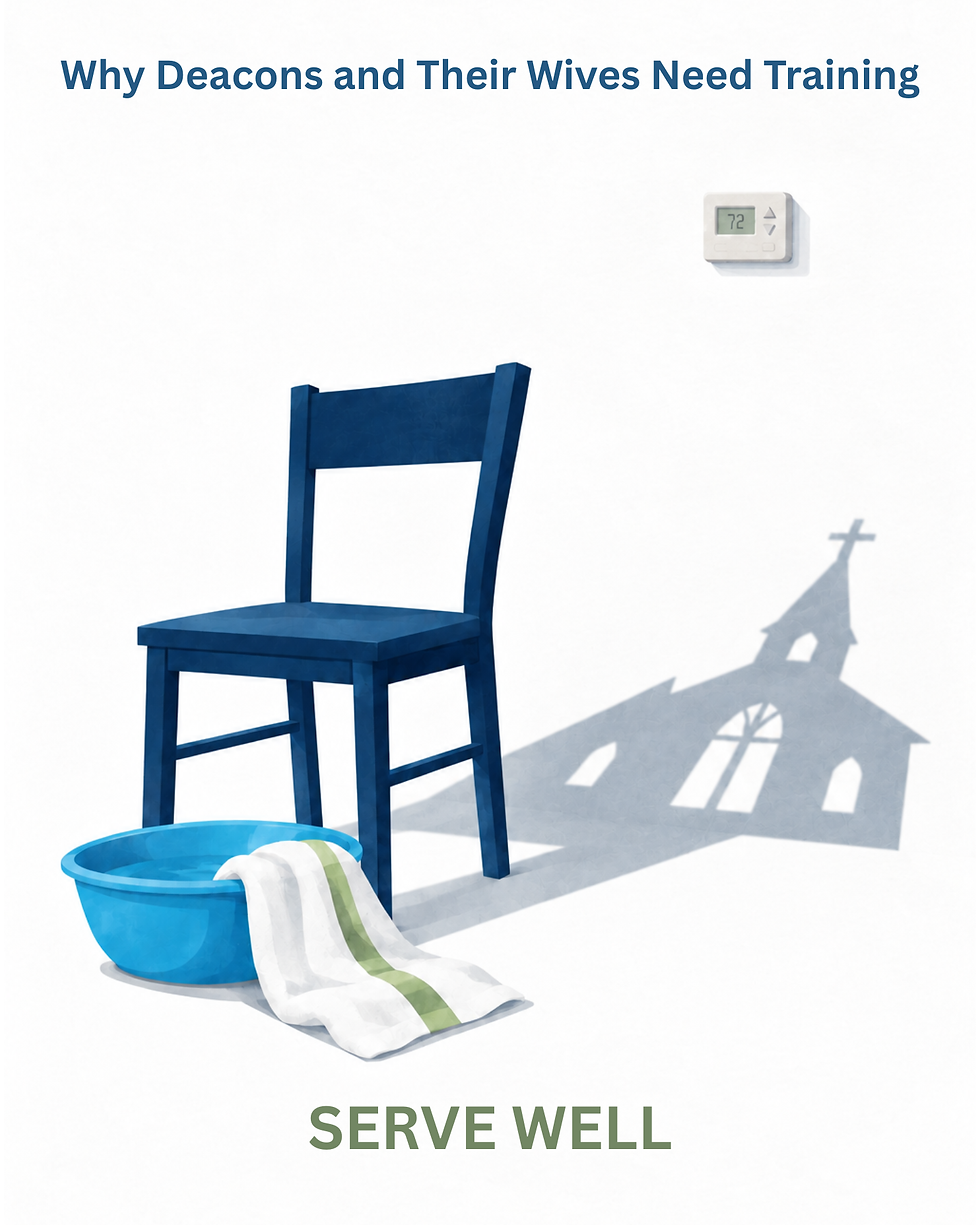
Every Baptist church I know has at least one person who can find the thermostat blindfolded, in the dark. Oddly enough, you won’t find that skill listed in 1 Timothy 3. Scripture expects much more of a deacon, and honestly, so should your church.
Deacons are the folks who show up where ministry gets messy—hospital rooms, church hallways, budget meetings, and those conversations that always seem to start with, “Now, I’m not gossiping, but...” I recently read a Baptist Press article, by my friend Aaron Summers, that reminded me how many crucial conversations deacons need to be ready for.1 A church key and a list of families are handy, but neither one tells you how to listen to someone who’s grieving or what to do when a rumor starts running laps around the fellowship hall.
The church cannot ordain instinct
The Baptist Faith and Message names deacons as one of the church’s two scriptural offices.2 In Acts 6, overlooked widows exposed a real need and a real threat to unity. The church appointed spiritually qualified servants to address the problem while its leaders stayed devoted to prayer and the ministry of the Word. First Timothy 3 stresses character, honesty, sound faith, and tested dependability.3
Notice what the apostles didn’t say: “Congratulations, gentlemen. Just figure it out by Wednesday.” Biblical qualifications matter, but so does getting ready for the real work ahead. Deacons need to practice meeting needs, building trust, and supporting their pastors—without accidentally becoming the church’s unofficial second pastor. Good resources on deacon ministry help connect servant hearts to real service, not just a name on an election ballot.4

Training isn’t a criticism of good men. It’s one of the best ways to care for them—and for the church family that counts on them. God’s people deserve servants who know what Scripture says and also know what to do when a neat answer runs headlong into a messy situation.
What Karen and I teach
Our training, Serve Well: Deacons and Wives Who Strengthen the Church, brings biblical conviction into the everyday life of the church.5 I help deacons see their calling to meet real needs, protect the peace, support their pastor’s ministry, and serve without confusing responsibility with authority. We practice noticing the person who’s gone quiet, listening before jumping to conclusions, asking questions that get to the heart of the matter, and speaking the truth with grace.
We start by asking deacons to consider why the church has trusted them with this work. I like to say a towel is a better picture than a gavel—servants notice needs and help others join in the care. Deacons support their pastor’s calling to prayer and the Word, but that doesn’t mean he has to handle every meal, every ride, and every tough conversation alone. And being helpful doesn’t mean running the church from the fellowship hall.
We also tackle that classic Baptist habit—telling a third person what we really ought to tell the first. A deacon needs to turn down gossip and triangulation, correct falsehood without turning it into a wrestling match, and know when it’s time to bring in the pastor. Otherwise, a simple misunderstanding can turn into a committee meeting before you’ve even had lunch. We talk about confidentiality, supporting the pastor, and knowing when helping someone has crossed over into rescuing them.
When we talk about communication, we ask deacons to listen in a way people can see and to speak with care. What did the member really say? What do we still not know? Are they asking for practical help, spiritual counsel, or just someone who will stick around long enough to hear the whole story? Saying “I’ll pray for you” is a real promise, but it shouldn’t become the church version of a quick exit. Prayer and follow-through go hand in hand.
Karen works with the wives on character, spiritual health, caring for women and families, wise communication, discretion, and setting healthy limits. First Timothy 3:11 describes women marked by dignity, faithfulness, and a refusal to slander.6 Just because you’re married to a deacon doesn’t mean you suddenly have the spiritual gift of endless casseroles. Wives have different gifts, responsibilities, and seasons of life. Karen helps each woman think through where she can serve well, when to bring in a pastor or another helper, and when a loving “no” is the right answer.
A deacon’s wife may hear concerns from women who aren’t comfortable talking to a male deacon. That trust is precious, and so is knowing how to use it wisely. Karen talks about how to listen, pray, ask permission before sharing sensitive information, and spot when a situation needs more help than you can give. The wife doesn’t have to play detective, become a counselor, or broadcast someone’s pain to the prayer chain. Compassion without discretion can end up hurting the very person we want to help. Couples also talk about what they can offer together, without taking on more than they should.
Practice while the crisis belongs to someone else
One of my favorite parts of the training is when deacons and wives work through real-life case studies. These are the kinds of decisions that make or break ministry in any church. We don’t ask anyone to memorize a perfect answer. Instead, we ask them to weigh the facts, apply Scripture, decide who needs to be involved, and respond faithfully.7
For example, what do you do when the congregation thinks the benevolence ministry has missed a few families? Accusations start flying, and longtime volunteers feel like they’re under attack. Should a deacon repeat the accusation, ask better questions, or call an emergency meeting? Or what about when a caregiver admits he’s just about out of strength? What should the deacon ask next, and how can he help without pretending to be a counselor? And when a family’s private crisis turns into public gossip, the wives talk about how to protect the family, correct a false story, and keep the church group chat from turning into the parking-lot grapevine.
That benevolence case is about more than whether someone got a check. Who might have been missed? What facts can be checked? How do deacons honor tired volunteers while still taking worried families seriously? The caregiver case reminds us that listening is urgent—when someone says, “I’m not sure I can keep doing this,” they need a gentle question, not a sermon. The rumor case shows the wives that discretion is real ministry. You can correct a lie without sharing every true detail you know.
We also look at the case of a compassionate couple who have slowly taken on just about everything for an older member. Their kindness is real, but so is their exhaustion and the strain on their own family. They have to figure out what belongs to them, what should be shared with other church members, and how to say yes to loving care without saying yes to every single request.

We give everyone time to talk through several possible responses, not just vote on the right answer. Real ministry usually means taking a first step, having a follow-up conversation, and sometimes handing things off to someone better equipped for part of the need. The case studies let us learn from another deacon’s judgment or a wife’s insight. The goal isn’t for everyone to say exactly what I would say, but for them to leave more ready to serve their own people well.
These discussions aren’t games with trick answers. They give deacons and wives a chance to test their judgment with each other before the real phone call comes in. Grace Fellowship, our made-up case-study church, can survive a clumsy first response. Your church might have to live with it.
Faithful service has limits
Some church servants think that if they can help, they must help, and if they ever say no, they’ve let God down. I get it. But I also know that kind of thinking can wear out a household and quietly teach everyone else to leave ministry to the same few reliable folks.
God is unlimited. We are not. Jesus took time to pray, didn’t answer every need the same way, and said He finished the work His Father gave Him.8 Sometimes saying no to one request lets a deacon say yes to what God actually called him to do. Sometimes the faithful answer is yes; sometimes yes with help; and sometimes no. We talk through those choices honestly, without acting like sacrifice is foolish or burnout is a badge of honor.
Boundaries are a lot easier to talk about in a classroom than in your kitchen with a lonely neighbor. That’s why we practice giving a clear, kind answer and inviting the church to help carry the load. A boundary shouldn’t be a sneaky way to disappear, and one household shouldn’t become the church’s entire ministry plan. Christ calls His body to care for one another, not to give every need to whoever picks up the phone.
The goal isn’t to make deacons less compassionate. It’s to make their compassion truthful, shared, and sustainable. Jesus already has the Savior job. No church needs a deacon or a deacon’s wife trying out for it.
A stronger church starts with prepared servants
Healthy deacon ministry is often almost invisible—a widow gets help, a grieving man finds a listening ear, a rumor stops before it splits friends, and a pastor can keep his focus on shepherding and the Word. Another Baptist State Convention talks about leadership development in terms of character, capacity, context, and competence.9 None of that just shows up when someone’s name goes on a ballot.

Karen and I would love to help your church get its deacons and their wives ready for the ministry they’ll actually face. Our training brings Scripture, honest conversation, and real-life case studies into the same room. We teach because Christ loves His church, His gospel is worth representing well, and servants need more than good intentions to care for His people.
If your last deacon training involved an overhead projector, I think we can agree it’s time for an update. Email us at jimmy@fairburnba.org to talk about scheduling Serve Well for your church. Give your deacons and wives a chance to practice before the next crisis comes calling. The thermostat will survive.
Endnotes
1. Baptist Press, “Empowering Deacons: 5 Crucial Conversations,” November 12, 2024, https://www.baptistpress.com/resource-library/bptoolbox/empowering-deacons-5-crucial-conversations/.
2. Southern Baptist Convention, “VI. The Church,” The Baptist Faith and Message 2000, https://bfm.sbc.net/.
3. The Holy Bible, English Standard Version (Wheaton, IL: Crossway, 2016), Acts 6:1–7 and 1 Timothy 3:8–13. Scripture quotations in this article are from the ESV.
4. Robert H. Thune, Gospel Training for Deacons: Equipping Servant Leaders (Greensboro, NC: New Growth Press, 2024); Matt Smethurst, Deacons: How They Serve and Strengthen the Church (Wheaton, IL: Crossway, 2021).
5. Jimmy Kinnaird and Karen Kinnaird, “Serve Well: Deacons and Wives Who Strengthen the Church,” unpublished leader teaching script and participant materials, 2026.
6. The Holy Bible, English Standard Version, 1 Timothy 3:11.
7. Kinnaird, “Serve Well,” including the Grace Fellowship Church case studies, 2026.
8. The Holy Bible, English Standard Version, Mark 1:35–38; Luke 5:16; John 17:4.
9. Baptist State Convention of North Carolina, “Equipping Tracks,” https://ncbaptist.org/ministries/leadership-development/equipping-tracks/.


Jimmy,
Thinking about sharing this with the deacon Board. Thanks for the good thoughts,
Pat