

AFTER THE ATTIC LIGHT: Why Reform Must Become Character


The attic light is on now. We can see the dust. We can name the junk. We can even haul it out in black trash bags and stack it neatly on the curb. But if the foundation is cracked, you can repaint every room and still wake up one morning with a door that won’t close.
That was the gift of The Light in the Attic series—God’s Word turning on the switch so we could finally see what had been hiding in the rafters of the house we inherited. We found the “blueprint” again. We remembered what the house was meant to be. We followed Josiah down that five-step pathway—Remind, Review, Refocus, Refine, Reform—because renewal isn’t a mood. It’s a movement. It’s the courage to “test and examine our ways, and return to the LORD.” (Lamentations 3:40, ESV)
And yet, if you’ve read the Scriptures with open eyes, you know the story does not end with a ribbon-cutting.
It ends with a sentence that lands like a gavel.
After Josiah does everything a reformer could do—after the idols are pulverized, the corrupt practices dismantled, the Passover restored—God’s Word gives us a line that feels like a cold wind through a newly cleaned room:
“Still the LORD did not turn from the burning of his great wrath.” (2 Kings 23:26, ESV)
How can that be?
How can reform be real—visible, tangible, aggressive—and still not be deep enough to stop the judgment?
That question is not ancient trivia. It’s a mirror. It forces us to confront the terrifying distinction between a change of policy and a change of person. It brings us to the threshold of our new series: Wide Witness, Deep Roots. Because as we are about to discover, you can clean an attic while the foundation of the house crumbles.
The Rubber Band Effect
When the leader is gone, what remains? That is the ultimate test of any renewal movement.
Josiah’s reforms were not imaginary. They were sweeping. They were costly. They were courageous. They were public. They were measurable. You could drive from town to town and see altars torn down, “high places” defiled, idols crushed into dust. You could point to statutes, policies, ceremonies, and new rhythms. It was a wide witness.

But when Josiah died in battle, the national soul snapped back like a rubber band. The next king “did what was evil in the sight of the LORD,” and so did the next one, and the one after that. (2 Kings 23:32, 23:37) The reforms were wide—but they were not deep.
The speed of the reversal is nauseating. It reveals a brutal lesson for our own unhinged age: a culture can be pressured into better behavior for a season without ever learning to love what is good. And when the pressure lifts—when the leader leaves, when the consequences feel distant, when the crowd moves on—what you love resurfaces.
That is why “values” matter so much, even if we rarely talk about them in church.
Your values are not your social media posts. Your values are not your bumper sticker slogans. Your values are not what you say you believe when the room is watching.
Your values are what you protect when it costs you something. They are what you reach for when you are afraid. They are what you excuse when you are angry. They are what you secretly envy when you think nobody is looking.
Values are the deep currents. Behavior is the surface. And a surface can look calm right up until the tide turns.
Judah’s tragedy was not merely that they failed to execute reform. It’s that they did not become a different kind of people. They stopped the rituals (for a time), but they didn’t stop the longing.
The Fatal Flaw
In the last post of the series, we named the fatal flaw plainly: the reform was “wide—it covered the whole map—but it was not deep.” Josiah could change structures. He could break idols. He could restore ceremonies. But he could not reach into the human heart and reshape what the people loved.
That is not an insult to Josiah. That is the boundary line God drew around every merely human reformer.
And here is where our moment in history becomes uncomfortable.
We are living through an age of loud moral claims and thin moral roots.
We have phrases for everything and patience for almost nothing. We have hashtags for justice and a shrinking vocabulary for holiness. We can diagnose everybody else’s character defects in ten seconds—and then we cannot endure ten minutes of quiet self-examination without numbing ourselves on a screen.
Yes, I’m on fire! And yes, I struggle too!
We are awash in opinions, but starving for wisdom. We are saturated with “takes,” but confused about truth. We are drenched in pleasure, but doubt what goodness is. We are surrounded by images, but uncertain how beauty should shape the soul.
That is not just “out there.” It creeps into the church. It is in the church.
We can build crowds without building character. We can build platforms without building saints. We can grow wide and still remain shallow. And the terrifying part is that we may not realize it until the Josiah-like leader is gone.
The Dragon Can Be Gone, But The Sickness Can Stay
We struggle to understand this because we tend to think of sin as a list of bad things we do, rather than a condition of the heart. We think if we remove the "bad thing," we are cured.
This is where the literary genius of J.R.R. Tolkien becomes a diagnostic tool for the soul. In The Hobbit, the physical dragon, Smaug, is the obvious enemy. He represents the external threat—violent, hoarding, fiery. Eventually, the dragon is shot down. The beast falls into the Long Lake. The external evil is removed.
But peace does not come. Instead, “dragon-sickness” descends upon the mountain.
Thorin Oakenshield, the leader of the dwarves, begins to act like the dragon. He hoards the gold. He refuses to share with the needy men of Lake-town. He becomes paranoid, suspicious, and cruel. He wanders the treasure room, obsessed with the Arkenstone, the “Heart of the Mountain.”
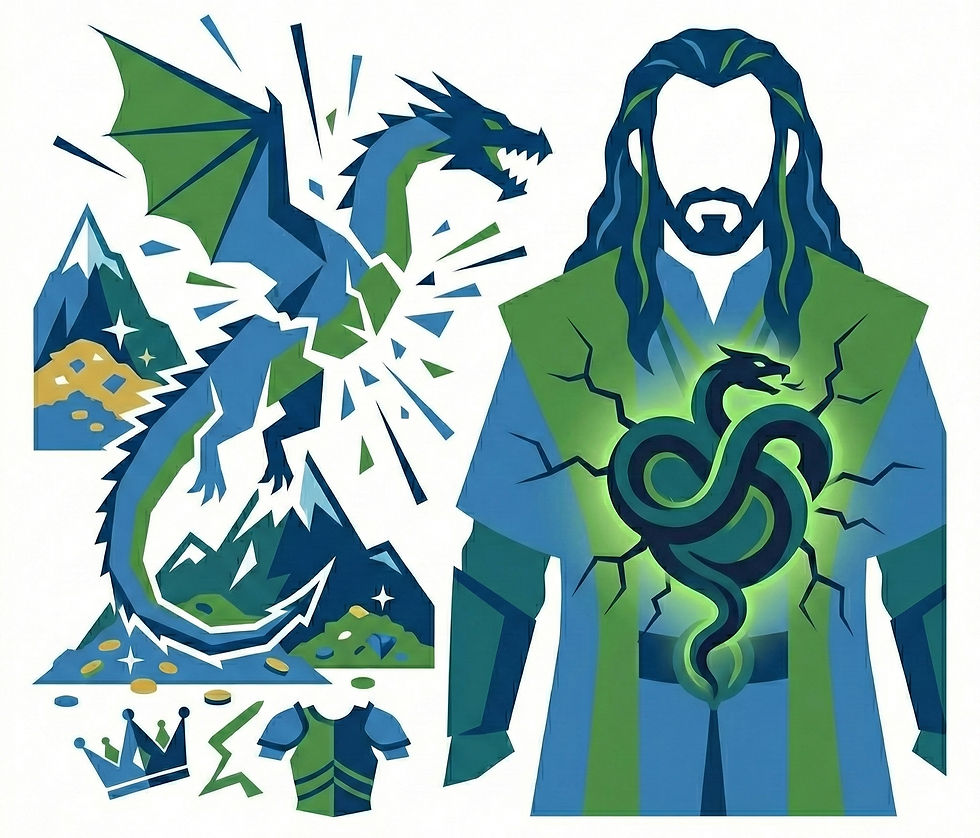
Tolkien is showing us a profound theological truth: The dragon can be gone, but the sickness can stay.
You can remove the idol (Smaug) and still keep the idol’s values (Greed). You can fire an abusive pastor (removing the dragon) but retain the culture of narcissism and power-worship that created him (dragon-sickness). You can stop a specific behavior—drinking, overspending, doom-scrolling—but retain the internal emptiness and desire for escape that drove the addiction.
This is the danger of the “Wide Witness” without the “Deep Roots.” We become people who have cleaned up our behavior but haven't cured our dragon-sickness. We have reform, but we don't have resemblance to Christ.
Men Without Chests
If Tolkien diagnoses the sickness, his friend, C.S. Lewis shows us the anatomy of the cure. In his prophetic work The Abolition of Man, Lewis argues that the modern world is producing a terrifying new species of human: “Men without Chests.”
Lewis described the human person in three parts:
The Head: The Intellect (Reason).
The Belly: The Appetites (Instincts, Desires, Urges).
The Chest: The Sentiments (Trained Affections, Virtue, Honor).
The ancient view was that the Head rules the Belly through the Chest. The Chest is the seat of value. It is the part of you that feels a proper sense of awe at a sunset, a proper sense of outrage at cruelty, and a proper sense of reverence for the holy. It is the stabilizer.
But, Lewis warned, we are creating an educational system and a culture that produces "Men without Chests." We are cultivating giant Heads (we have more information than any generation in history) and we are unleashing giant Bellies (we are consumer-driven, appetite-led creatures). But the middle element—the character, the virtue, the Chest—is wasting away.
Lewis writes with chilling accuracy:
“In a sort of ghastly simplicity we remove the organ and demand the function. We make men without chests and expect of them virtue and enterprise. We laugh at honour and are shocked to find traitors in our midst.”1
Does that not describe our “unhinged age”? We are trying to build a Kingdom with people who are merely clever and hungry. It won't work.
The Scouring Of The Shire
So, where do we go from here? If cleaning the attic isn't enough, what is?
We must move from renovation to reconstruction. We must go downstairs, into the load-bearing beams of the soul.
In The Lord of the Rings, there is a chapter often skipped by the movies but essential to the book: “The Scouring of the Shire.” After the Ring is destroyed and Sauron is defeated (the Big Reform), the hobbits return home only to find that the Shire has been corrupted. It hasn't been destroyed by a dark lord; it has been ruined by petty, bureaucratic evil. Trees are cut down, ugly brick mills are belching black smoke, and endless “Rules” are posted on the walls.
It is a drab, gray, technocratic evil—the kind that sucks the joy and beauty out of life. It is the evil of “gatherers and sharers,” of systems that control rather than cultivate.But here is the key: Gandalf does not save the Shire. He stands back. He tells the hobbits, “You must settle its affairs yourselves; that is what you have been trained for.”2
The journey—the suffering, the discipline, the fellowship, the terror—had formed them. It gave them “Chests.” It gave them deep roots. Because they had been formed by their walk with the King, they were able to uproot the evil at home. They didn't just have a victory; they developed virtue.
Building A Palace, Not A Cottage
This brings us to the heart of this new series. We are moving from the "Light in the Attic" to "Deep Roots" because God is not interested in merely fixing your roof. He is interested in taking up residence in your soul.
In Mere Christianity, Lewis offers one more metaphor that will guide us. He asks us to imagine ourselves as a living house. God comes in to rebuild that house. At first, you think He is just fixing the drains and stopping the leaks (the Josiah reforms). You’re happy with that.
But then, He starts remodeling the house in a way that hurts immensely. He’s throwing out a new wing here, adding an extra floor there, running up towers, making courtyards. You thought you were being made into a decent little cottage, but He is building a palace. “He intends to come and live in it Himself.”3
This is why character formation hurts. This is why it takes time. Deep roots require deep digging.
It Could Have Been Different
Scripture tells us plainly that Judah’s judgment was not random. It was moral, covenantal, and long-accumulated—provoked by generations of rebellion and bloodshed (2 Kings 23:26-27). And after Josiah’s death, the kings and the people did not merely drift; they returned to evil quickly (2 Kings 23:31–24:1)
So here is the connecting point between the series we just finished and the one we are about to begin:
If Judah had undergone deep character formation—if the people themselves had become “Josiah-like” in their loves, their values, their worship—then Josiah’s death would not have been the end of renewal.
A single leader can ignite reform. But only a formed people can sustain it.
This is why God’s promise in the prophets is not merely, “I will give you better rules.” It is, “I will give you a new heart ” (Ezekiel 36:26, ESV). And it is, “I will put my law within them, and I will write it on their hearts” (Jeremiah 31:33, ESV).
That is not superficial religion. That is renovation at the level of desire.
That is character.
What Is Meant By “Christian Character”
When I say “character,” I do not mean personality type. I do not mean whether you are introverted or extroverted, wired like a deacon or wired like a worship leader.
I mean the kind of person you are becoming in Christ.
Character is the settled direction of your heart, displayed through your habits, under pressure.
Character is what remains when nobody is clapping.
Character is what your spouse experiences when the church crowd is gone.
Character is what shapes your words when you’re tired, your decisions when you’re afraid, your integrity when it would be easy to hide.
And here is the critical link: character is values made visible. Values are internal commitments; character is the embodied pattern they produce.
So if we want churches that are strong when cultural winds shift, we must stop treating virtue like a decorative accessory. We must return to it as discipleship’s core outcome: Christ formed in us.
It is painful. It is hard. It was for Paul who was in anguish over this very thing with the believers in Galatia (Galatians 4:19). Many will not even try. There are many hearers of the Word, and not doers of the Word.
Why This Next Series
The Light in the Attic series gave us a needed pathway. It showed how God uses His Word to expose the junk and call His people to look honestly and turn decisively.
But the “wide but not deep” warning forces a new question:
What kind of disciples can outlive the reformer?
What kind of church can endure when the cultural scaffolding collapses?
What kind of people can love the true, the good, and the beautiful—not as abstract ideals, but as a way of life rooted in the character of God?
That is what this next series is about.
I have been thinking about these things for years. I have written page after page of notes, trying my best to articulate it in a way that will resonate. I have delayed putting my thoughts and especially my solutions out there. But, now is the time. So in the next blog installments, and there will be many, we are going to talk about:
The Transcendentals (truth, goodness, beauty) and why confusion about them produces moral chaos.
Values—where they come from, how they form, why they harden, how they change, and how Christian values differ from worldly values.
Virtues—not as Victorian politeness, but as Spirit-formed strength (the kind that can forgive, endure, repent, and remain faithful).
The Life and Teachings of Jesus along with other New Testament Passages—because Christian character is not a generic “be nice” project; it is conformity to Christ in heart, head, and hands.

If the last series was about turning on the attic light and beginning the clean out, this one is about going downstairs—into the load-bearing beams of the soul—and letting the Lord do the deeper work that keeps the house standing.
Because the goal is not merely reform.
The goal is resemblance.
Not merely that we look like a church.
But that we become like Christ.
End Notes
1Lewis, C. S. The Abolition of Man or Reflections on Education with Special Reference to the Teaching of English in the Upper Forms of Schools. HarperOne, 2001, p. 26.
2Tolkien, J.R.R. The Lord of the Rings. William Morrow, Illustrated Edition, 2021, p. 996.
3Lewis, C. S. Mere Christianity. HarperOne, 2001, p. 205.

Comments